

 There is a short stretch every year in Hampton Roads when the weather actually cooperates. The humidity finally breaks, the ladder is safe to climb, the crawl space is not a sauna, and caulk will cure instead of sitting there wet. In Chesapeake, that stretch is October.
Then it closes. Once the first real cold front comes through, every job on this list gets harder, more expensive, or impossible until March.
That is the whole point of this post. Not “here are some fall tips.” This is your last comfortable window to fix things before winter locks them in.
Why Is October The Last Real Window For Home Maintenance In Hampton Roads?
Because everything on a coastal Virginia home that is going to fail this winter is already damaged right now — you just cannot see it yet.
The Atlantic hurricane season does not end until November 30, and Chesapeake has spent months absorbing wind, driving rain, and the kind of humidity that never really lets go. Every one of those events left something behind: a lifted shingle edge, a loosened flashing, a saturated crawl space, a corroded fastener. None of it announces itself. It sits quietly until the first freeze or the first hard winter rain turns a small defect into water inside your house.
Wait until you notice a problem and you are no longer doing maintenance. You are doing emergency repair, in January, at whatever price the one available contractor decides to charge.
What Should You Check On Your Roof After Storm Season?
Start at the roof, and start from the ground with binoculars before you consider a ladder.
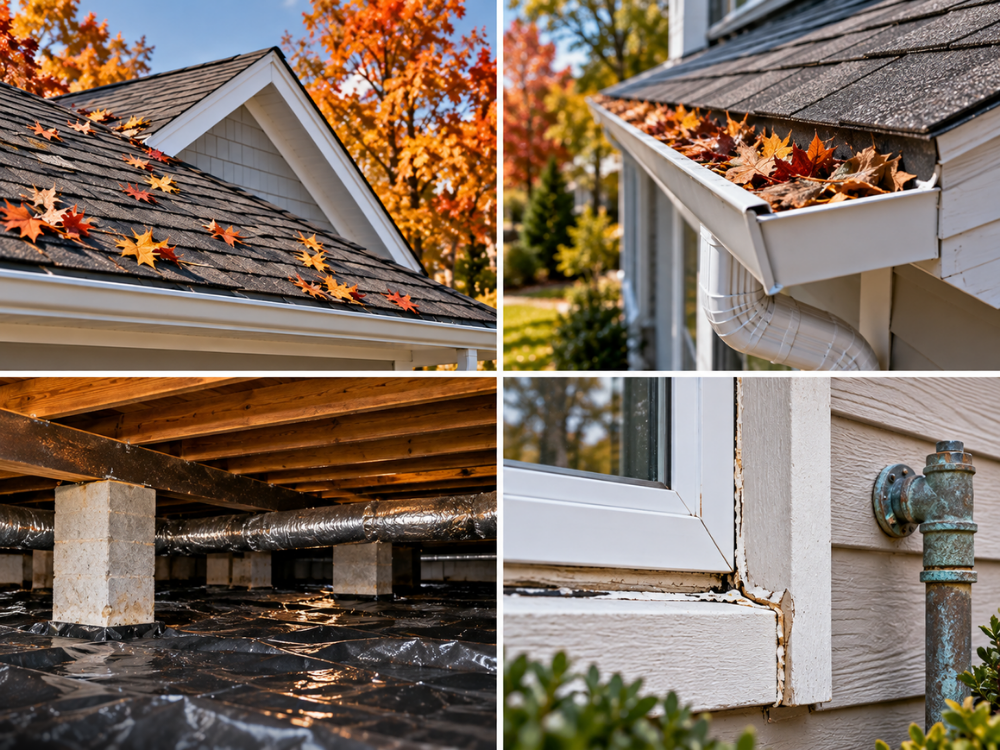
You are looking for shingles that are lifted, curled, cracked, or missing outright. Look at the edges and the ridge first — wind damage almost always starts where the shingle is least anchored. Look for dark patches where the granule coating has worn off, which is what happens after strong wind and wind-driven rain scour a slope.
Then look at the penetrations. Every place something comes through your roof is a place water can get in: chimney flashing, vent boots, the rubber collars around plumbing stacks, and the valleys where two slopes meet. Cracked pipe boots are one of the most common sources of ceiling stains in this region, and they are cheap to replace before they leak and expensive to deal with after.
Finally, check your gutters and downspouts before the leaves finish coming down. Clear out the summer debris, then make sure water is discharging well away from the foundation — not dumping at the corner of the house. Hampton Roads soil does not drain fast. Water that pools against a foundation in November is a moisture problem by February.
If something up there concerns you, deal with it now. A lifted shingle in October is a repair. The same shingle in March is a conversation about roof decking.
How Do You Get Your Crawl Space Through Winter?
Go look at it. That is the honest answer, and it is the step almost every Chesapeake homeowner skips.
Most homes in this market sit on crawl spaces, and those crawl spaces just came off a full Hampton Roads summer. Warm, humid air has been condensing on cool surfaces under your floor for months. What you want to find down there is a vapor barrier that is intact and still covering the ground, dry framing, and no standing water.
What you do not want to find — but should look for anyway — is a torn or displaced plastic barrier, water sitting in low spots, dark staining or fuzzy growth on floor joists, soft or crumbling wood near the perimeter, or insulation that has fallen away from the subfloor. Any of those means moisture is already winning.
 Also check the crawl space vents and the access door. A door that will not seal is an open invitation to both cold air and animals looking for somewhere warm in December.
A damp crawl space heading into winter does not stay a crawl space problem. It becomes a wood rot problem, a mold problem, and eventually a floor problem.
What Does Salt Air Do To A Coastal Virginia Home Over The Winter?
Salt air corrodes metal, and your house is held together and served by metal.
Before winter, walk the exterior and look specifically at the hardware: light fixtures, railing anchors, hose bibs, HVAC condenser fins and the disconnect box, deck fasteners and joist hangers, garage door springs and rollers, and the roof flashing and drip edge. Rust streaks are the tell — where you see them, something metal is losing material, and winter moisture accelerates it. Rinsing salt residue off the condenser and exterior fixtures with plain water takes ten minutes and meaningfully extends their life.
While you are out there, check the caulk where siding meets trim, where trim meets windows and doors, and where pipes, cables, and dryer vents penetrate the wall. Cracked or shrinking caulk is a direct path for water and cold air into a wall cavity. A tube of exterior caulk costs almost nothing. Rotted sheathing does not.
What Needs To Happen Before The First Freeze?
Anything holding water outside the heated envelope of your house.
Disconnect and drain garden hoses so water is not sitting in the spigot when temperatures drop. Shut off and drain any irrigation or outdoor supply lines you can isolate. If you have exposed piping in the crawl space or garage, confirm the insulation is still in place. Chesapeake still gets hard freezes, and a burst hose bib line floods the same as anywhere.
Inside, change your HVAC filter before you switch over to heat, and clear the space around your indoor unit. Test every smoke and carbon monoxide alarm — heating season is exactly when CO risk rises. And check your dryer vent flap outside to confirm it opens and closes freely. Lint buildup behind a stuck flap is a fire hazard, full stop.