

What if the most important clue about a home’s sewer line is hidden underground, beyond anything you can see during a walkthrough? A sewer scope inspection Portsmouth buyers can include in due diligence uses a camera to assess accessible sections of the main drain line before a purchase decision.
It’s natural to want a clear answer: Is the line in good condition, or are there signs that need attention? A camera may show visible concerns such as cracks, blockages, or root intrusion, but its view has limits. It assesses only the piping the camera can access and see during the inspection. It can’t guarantee that every defect will be found or predict how the line will perform in the future.
This guide explains what a sewer scope can show, how to interpret its findings, and how to plan the inspection as part of your Portsmouth property due diligence. A Premier Home Inspection provides a sewer scope and detailed reporting to help you understand documented observations and make a more informed decision about the property.
Key Takeaways
- A sewer scope inspection Portsmouth buyers include in due diligence adds focused information about accessible underground piping to a broader property evaluation.
- Understand what the camera could reach and see so you can distinguish documented observations from questions that remain open.
- Review each finding by asking what was observed, where it was seen, why it may matter, and what remains uncertain.
- Coordinate access to the sewer-line entry point and schedule the inspection early enough to review the report before relevant transaction deadlines.
- A Premier Home Inspection’s detailed report can help you use scope findings as part of an informed property decision.
What a Sewer Scope Inspection in Portsmouth Checks, and Why Buyers Consider One
A sewer scope is a visual assessment of accessible sewer piping. An inspector guides a camera through the line and observes its interior. It is a focused inspection, not a general home inspection: the camera shows visible portions of the pipe, while a broader property inspection considers other accessible components of the home. This method is an example of pipeline video inspection, also known as sewer camera inspection.
A home can have working sinks, toilets, and drains while a buried section of pipe remains out of view. Water flowing during a visit doesn’t prove the entire line is free of defects. A sewer scope inspection Portsmouth buyers consider adds a visual record of accessible piping to the information gathered during the rest of their property evaluation. It documents observations, but it doesn’t guarantee that every issue will be found or predict future performance.
Which part of the sewer system does a scope assess?
The sewer lateral carries wastewater away from the property toward the public sewer system. A camera scope can assess sections it can enter and travel through from an available access point. How much of the line is visible depends on the access and conditions inside the pipe. The camera may not show every section from end to end.
The lateral may run from the home across the property toward public sewer infrastructure. The property boundary and the camera’s reach are separate matters. A scope describes what was visible along the accessible route; it doesn’t determine who owns or maintains each section. Keeping those points distinct helps buyers read the report without treating it as a decision about responsibility.
Why consider a sewer scope before buying in Portsmouth?
Most of a sewer line is concealed underground. A walkthrough, even with normal drainage, can’t provide a visual assessment of the pipe itself. A scope adds another kind of evidence to a buyer’s review, especially when the condition of inaccessible piping is an open question. In Portsmouth, as with any property purchase, focus on what the camera actually showed rather than assuming that a normally working drain confirms the line’s condition.
Documented observations can help you frame useful follow-up questions. If a report notes an irregularity, look at its location and extent in the inspected view, then decide whether further evaluation is warranted. The observation alone may not establish its cause or full significance. A clear report separates what was seen from what remains uncertain.
A sewer scope complements rather than replaces a buyer’s home inspection. The two assessments provide different information: the scope brings accessible portions of a concealed system into view, while the home inspection supports a broader understanding of the property.
How a Portsmouth Sewer Scope Uses a Camera to Examine the Line
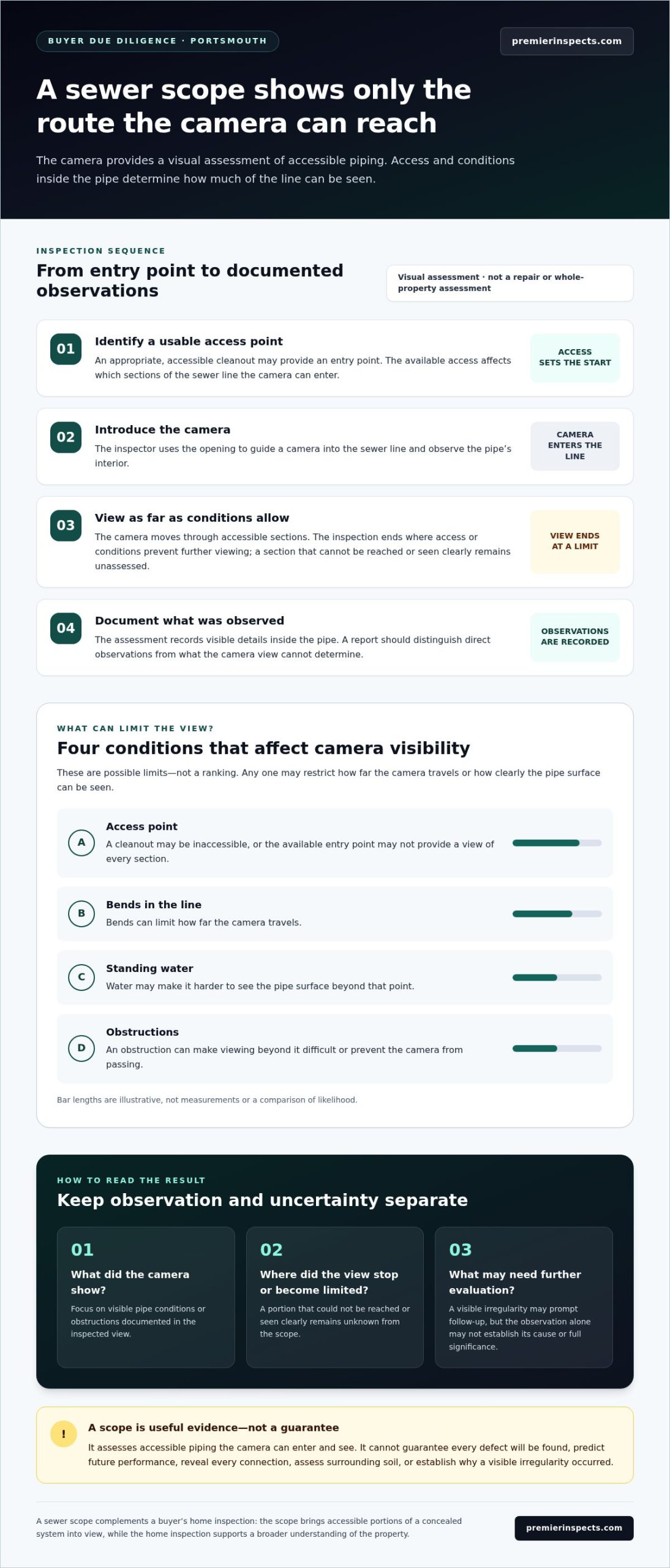
A sewer scope follows a practical sequence: identify a usable access point, introduce the camera, view the pipe as far as conditions allow, and document the observations. For a sewer scope inspection Portsmouth buyers schedule, the camera provides visual information about accessible sections of the line. It isn’t a repair, engineering, or whole-property assessment.
When an appropriate cleanout is available and accessible, it may provide an entry point. The inspector uses the opening to guide the camera into the sewer line and observe its interior. The extent of the view depends on access and conditions inside the pipe. If the camera can’t pass a section or visibility is limited, that portion can’t be considered visually assessed.
What happens during the camera inspection?
The inspector first identifies an entry point that provides access to the line. The camera is then introduced and moved through accessible sections while the inspector observes the view. The assessment records visible details inside the pipe rather than relying only on whether wastewater appears to flow. The camera inspection ends where access or conditions prevent further viewing.
Findings may include visible pipe conditions or obstructions. The report should distinguish what was directly observed from what the camera view can’t determine. InterNACHI’s Sewer Scope Inspection Standards of Practice offers a reference for understanding the purpose and limitations of this type of inspection and the role of reporting.
What can affect the camera view?
Not every line offers a clear, uninterrupted route. A cleanout may be inaccessible, or the available entry point may not provide a view of every section. Bends can limit how far the camera travels. Standing water or an obstruction may also make it harder to see the pipe surface beyond that point.
These limits matter when you read the results. If a section can’t be reached or seen clearly, its condition remains unknown from the scope. The camera doesn’t reveal every connection, assess the surrounding soil, or establish why a visible irregularity occurred. A visual observation is useful evidence, but it isn’t a complete diagnosis of the sewer system.
Use the report to separate three things: what the camera showed, where the view stopped or became limited, and what may need further evaluation. For example, a documented obstruction describes what was visible at the time. On its own, it doesn’t explain the obstruction’s cause or establish the condition of the pipe beyond it. This distinction helps buyers identify useful follow-up questions without treating an unseen section as either sound or defective.
Clear documentation makes the camera view easier to use as part of a purchase decision. A Premier Home Inspection provides Portsmouth sewer scope inspections as a focused addition to your property evaluation. You can schedule a sewer scope inspection.
How to Interpret Sewer Scope Findings Before a Portsmouth Home Purchase
A scope report is most useful when you separate what the camera showed, what the observation might mean, and what still needs clarification. A finding isn’t automatically a diagnosis, a complete repair plan, or a cost estimate. A sewer scope inspection Portsmouth buyers use for due diligence provides documented visual information to guide their next questions, not a final answer to every question about the line.
Start with the report’s specific wording and location. Terms such as “visible roots,” “standing water,” “crack,” “offset,” or “blockage” describe observations, but each needs context. How much of the pipe was visible? Where in the line was the condition recorded? Did the report describe restricted flow, or simply note something in the camera view? Those details are more informative than assuming a label alone establishes severity.
Which observations deserve careful review?
Roots, separated joints, visible damage, and restricted flow deserve attention because they may affect how the line appears or functions. However, the camera view may not establish the cause, full extent, or significance of an observation. Standing water, for example, is a recorded condition, not an explanation of why water is present. Read the inspector’s description and note any stated limits on visibility.
Use a simple review framework:
- Observation: What exactly is visible, and where in the inspected line?
- Possible significance: What concern could this raise, without treating that possibility as a confirmed diagnosis?
- Open question: What additional information or evaluation could clarify the finding?
This approach keeps your attention on the evidence and helps distinguish an isolated visual detail from a concern that may warrant further review. If the camera view ends before a noted area can be understood, the unseen portion remains unknown. It isn’t automatically clear or defective.
How should buyers use the report?
Review any recorded images or notes alongside the written findings. Matching a description to its location and visual context can make terms such as “offset” or “obstruction” easier to understand. If the report identifies a concern, consider whether further evaluation could answer the remaining questions. The inspection report records observations; it doesn’t prescribe repairs, determine a repair scope, or set a project price.
Keep those roles distinct during the purchase. You may use documented findings to inform your decisions or negotiations, but the camera observation itself doesn’t make those choices. A sewer scope adds a focused view alongside a buyer’s home inspection, which provides broader information about the property. Together, the reports can help you consider sewer-line observations in context while respecting what each assessment can and can’t establish.
How to Prepare for a Sewer Scope Inspection in Portsmouth
Start with access. A camera scope needs a usable entry point to view the sewer line, so coordinate with the seller, property contact, or agent to make the relevant cleanout or other access point reachable. If access is blocked or unavailable, the camera view may be limited. Don’t open, alter, or try to clear plumbing components yourself.
Plan the appointment around the transaction’s inspection schedule, leaving time to review the report and consider follow-up questions before relevant deadlines. Property access, coordination with the seller, and the timing of other inspections can affect what’s practical. Scheduling early helps avoid a rushed review.
What should be ready before the appointment?
Before the inspection, coordinate entry with the person who can provide access and share useful background with the inspector. Previous sewer documentation, if available, can provide context. You can also describe drainage concerns you’ve noticed or been told about. Sharing this information doesn’t predetermine the findings, but it helps ground the inspection and report in the property’s known history.
- Arrange property access and make sure the relevant entry point can be reached.
- Gather any available sewer-line records or previous inspection documents.
- Share known drainage concerns and details about when they occur.
- Keep the transaction’s inspection schedule and review deadlines in view.
These steps are part of broader home inspection preparation, especially when access and timing need to be coordinated across several assessments. The aim is straightforward: make it possible to reach the intended inspection point and leave time to understand the results.
When should a buyer schedule the scope?
Arrange the scope early enough in the inspection period to receive and review the findings while there’s still time to decide what questions remain. Avoid leaving it until the last moment. If the report documents an observation that needs clarification, an early appointment gives you more time to consider the information alongside the rest of your property evaluation.
Practical timing depends on transaction deadlines and property access. Coordinate the scope with the inspection schedule and make sure the person managing access knows the appointment plan. A well-timed inspection doesn’t guarantee a particular outcome, but it gives you an opportunity to understand documented observations before making purchase decisions.
Once access and timing are coordinated, schedule your Portsmouth sewer scope inspection.
Book a Portsmouth Sewer Scope Inspection with A Premier Home Inspection
An underground sewer line can leave buyers with important unanswered questions. A sewer scope adds focused visual information about accessible piping, bringing documented observations into your broader property evaluation. It won’t guarantee that every concern is found or predict future performance, but clear reporting can help you understand what was observed and decide what questions to consider next.
What makes this inspection useful to a buyer?
A Premier Home Inspection provides sewer scope assessments in Portsmouth and throughout Hampton Roads, including Chesapeake, Norfolk, Virginia Beach, Portsmouth, Suffolk, and Hampton. The business is veteran-owned and operated by Clay Somers, a Certified Master Inspector. Detailed reporting gives you a record of the accessible sewer line and the camera’s observations, rather than relying on how drains happen to work during a visit.
The scope is a focused service that complements a broader buyer inspection. Its value is in documenting visible conditions and helping you understand those observations in the context of a purchase. If the report notes a concern, it can help you identify what needs clarification or further evaluation. The report isn’t a repair plan or cost estimate, and the inspection doesn’t include repairs or remediation.
Clear boundaries matter. A camera view reflects only the piping it can access and observe under the conditions present during the inspection. A detailed report communicates findings and limitations, but it can’t establish the condition of areas outside the view. Keeping that distinction in mind helps ground decisions in the available evidence.
How to take the next step
Planning a purchase in Portsmouth? A sewer scope inspection Portsmouth buyers include in due diligence provides focused information about an otherwise concealed system. Coordinate the appointment with property access and your transaction’s inspection schedule so you have time to review the findings as part of your decision-making.
A Premier Home Inspection brings veteran ownership, Clay Somers’s Certified Master Inspector credential, and detailed reporting to this assessment. The goal is to provide useful documented observations that support an informed property decision, without overstating what a camera can reveal.
Move Forward With Clearer Property Decisions
A home purchase moves quickly, and uncertainty about a concealed system can weigh on your decision. A sewer scope inspection Portsmouth buyers include in due diligence is a practical way to get documented information about accessible portions of the drain line before moving forward.
Use the findings to inform your questions, not to dictate an answer on their own. A scope shows accessible piping at the time of inspection. What you choose to do with those observations depends on your priorities and the wider property picture. Clear information can help you move ahead thoughtfully, whether you need clarification or simply want a better-informed perspective.
Schedule your sewer scope with A Premier Home Inspection to add focused information to your property decision.
Frequently Asked Questions
Is a sewer scope inspection worth it if the drains are working normally?
It can be, because normal drainage doesn’t tell you everything about buried piping. When deciding whether a sewer scope inspection Portsmouth buyers may find useful, consider whether uncertainty about the line could affect your purchase decision. A scope may add useful information when comparing properties or deciding what follow-up questions to raise. Buyers in Portsmouth and nearby Hampton Roads communities, including Chesapeake, Norfolk, Virginia Beach, Suffolk, and Hampton, can weigh that information against their priorities.
Can a sewer scope inspection find every problem in a sewer line?
No. A scope can document only what the camera could access and see during the inspection. A clear view of one section doesn’t confirm the condition of parts beyond the camera’s reach or hidden connections, and it can’t predict how the line may perform later. Read the report for both observations and stated limits. If visibility ended before the camera reached an area you’re concerned about, treat that area as unassessed, not as confirmed to be in good or poor condition.
Can newer homes have sewer line problems?
Yes, a newer home can still have a sewer-line concern, but its construction date alone doesn’t show that a defect exists. For example, you may not have records of changes or maintenance after construction. That gap is a reason to review the available information, not proof of a problem. Base your view on documented observations and property-specific context rather than assuming a new build has a perfect line or an older line is defective.
Does a sewer scope inspect the city sewer main in Portsmouth?
Generally, a property scope focuses on accessible piping serving the property, not a full inspection of Portsmouth’s public sewer main. The camera’s endpoint depends on access and the inspection scope, so don’t assume it reaches municipal infrastructure. The camera also can’t determine who owns or maintains a section. For questions about public-system boundaries or maintenance responsibility, review relevant property records and consult the appropriate local authority.
Do I need a separate sewer scope if I am already having a home inspection?
A sewer scope is a separate assessment because it provides a camera view inside accessible sewer piping, while a general home inspection considers other aspects of the property within its scope. A walkthrough may reveal a plumbing fixture, for example, but it doesn’t show the concealed line beyond it. Whether to add a scope depends on the property and the information that would help you decide. Review each report for its specific coverage.
What happens if the sewer scope camera cannot pass through the line?
The inspector can report where the camera stopped and what was visible up to that point. That’s a limitation of the view, not a finding that the entire line has failed. Use the documented stopping point to identify what remains unanswered. If the unseen section matters to your decision, consider whether additional evaluation is appropriate. Don’t treat the scope as evidence about areas the camera couldn’t assess.
Who is responsible for a sewer line between a Portsmouth home and the public sewer?
A camera inspection doesn’t determine ownership or maintenance responsibility. The answer may depend on property boundaries, records, and local arrangements, so don’t infer responsibility simply from where an observed condition appears. If this affects your purchase, review available property documents and direct responsibility questions to the appropriate local authority. The scope report records visible conditions, not legal ownership or who must arrange maintenance.