

What if the exterior looks sound, but the clues that matter are easy to miss? For Hampton buyers, an EIFS inspection can help distinguish visible concerns from questions about what may be concealed behind the finish. As part of a broader buyer’s home inspection, an EIFS inspection Hampton buyers consider can document observable conditions, but it can’t establish what is inside a wall.
It’s reasonable to wonder whether a home has EIFS or traditional stucco, and whether cracks, gaps, or deteriorated sealant deserve attention. EIFS is a layered exterior system, not simply another name for traditional stucco. A visual assessment can document signs that merit follow-up. Thermal imaging, when appropriate, may add information, but it cannot confirm or rule out hidden moisture on its own.
This guide explains what EIFS is, which visible details to look for, and what a professional home inspection can establish. You’ll also learn how A Premier Home Inspection’s buyer’s inspection can document observable EIFS-related conditions as part of a wider property assessment, helping you weigh the findings and make a more informed decision about a Hampton home.
Key Takeaways
- Learn how EIFS differs from traditional stucco and why joints, sealants, and transitions deserve attention during a visual review.
- An EIFS inspection Hampton buyers include in a buyer’s home inspection can document visible concerns, but visual findings alone can’t establish concealed moisture or structural damage.
- Use a simple exterior checklist to note accessible surfaces, openings, and visible damage before reviewing the inspection findings.
- Understand the difference between a comprehensive home inspection and specialized testing so you can interpret the report’s scope.
- See how observable EIFS-related findings fit into a broader property assessment, with thermal imaging potentially adding information when appropriate.
EIFS Inspection in Hampton: What Buyers Need to Understand First
Concern about moisture behind an exterior finish is understandable: the surface may look neat while the wall layers behind it remain out of sight. That uncertainty doesn’t prove a home has a moisture problem. It does make it useful to understand the cladding, note visible conditions, and consider exterior findings alongside the rest of the property before making a purchase decision.
What EIFS is, and how it differs from traditional stucco
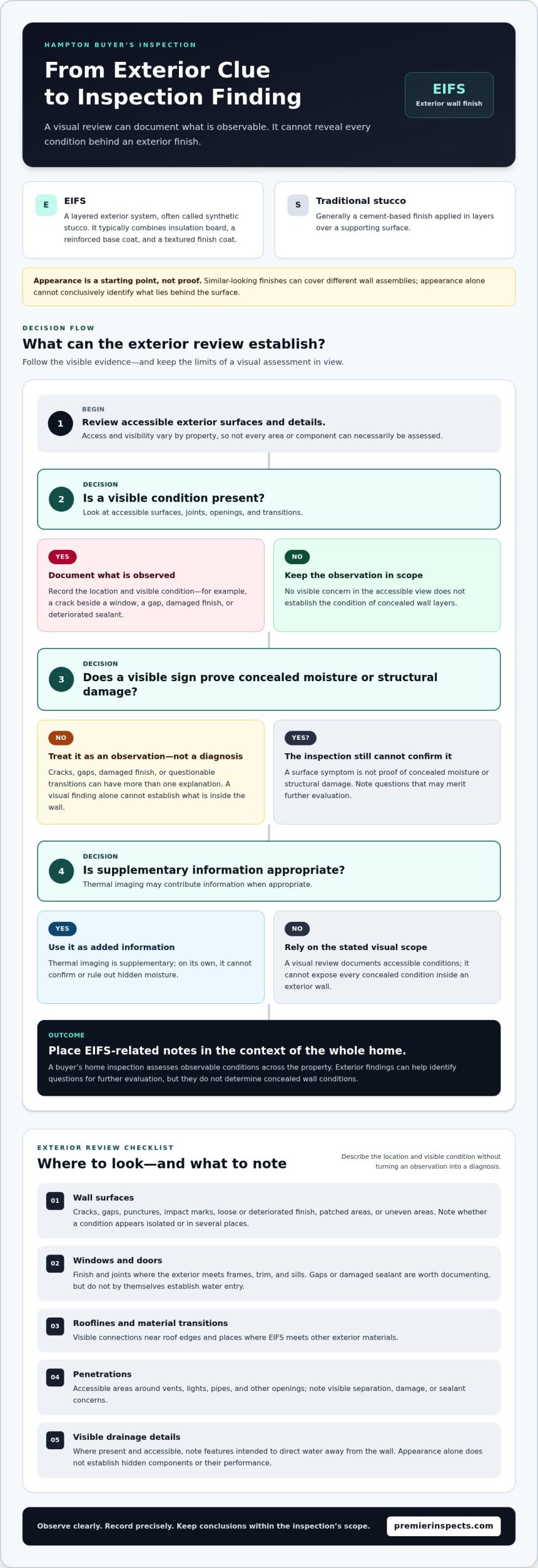
EIFS is a layered exterior wall finish system, often called synthetic stucco, that typically combines insulation board, a reinforced base coat, and a textured finish coat. Although its finished appearance can resemble stucco, EIFS is a different assembly.
Traditional stucco is generally a cement-based finish applied in layers over a supporting surface. EIFS includes an insulation layer as part of its exterior assembly, and materials and installation details can vary between systems. Neither name alone tells you exactly how a particular home was built. Similar-looking finishes can cover different wall assemblies, so appearance may raise a question but cannot conclusively identify what lies behind the surface.
The distinction matters because the materials and layers affect how the exterior is assembled. During a visual review, joints, openings, and transitions between materials are useful places to look closely. Identifying the finish is a starting point for understanding what can be assessed, not proof that the wall is performing well or poorly.
Why EIFS condition matters during a Hampton home purchase
Exterior condition is one part of a buyer’s due diligence. Visible cracking, gaps, damaged finish, or questionable transitions can be documented and considered with other observations. Each sign can have more than one explanation, so it shouldn’t be treated alone as a diagnosis of concealed moisture or structural damage.
Hampton is part of the Hampton Roads coastal region, making a property-specific review more useful than assumptions based on location alone. Consider the visible exterior, its connections, and the home’s overall condition together. Findings can help identify questions for further evaluation and give you clearer information as you weigh the property.
A buyer’s inspection looks beyond one cladding material. It assesses observable conditions across the home, putting exterior notes in the context of the wider property. A Premier Home Inspection serves Hampton and the wider Hampton Roads area with residential buyer inspections. Learn how a buyer’s home inspection can support your property assessment. An EIFS inspection Hampton buyers consider as part of this process can document visible concerns, but it can’t determine concealed wall conditions.
How an EIFS Inspection Assesses Visible Exterior Conditions
A useful exterior walkthrough is systematic, not just a quick glance from the driveway. During a buyer’s home inspection, an inspector assesses accessible surfaces and documents visible EIFS-related conditions within the broader property review. The report should help you understand what was observed, where it appeared, and why it may merit attention, without treating a surface symptom as proof of what lies behind it.
Exterior details that deserve careful observation
This checklist highlights details that may be considered during a visual review. Access and visibility vary by property, so not every area or component can necessarily be assessed.
- Wall surfaces: Note visible cracks, gaps, punctures, impact marks, loose or deteriorated finish, and areas that appear patched or uneven. Record where each condition appears and whether it is isolated or visible in several places.
- Windows and doors: Look at the finish and joints where the exterior meets frames, trim, and sills. Gaps or damaged sealant are worth documenting, but do not establish by themselves that water entered the wall.
- Rooflines and transitions: Review visible connections near roof edges and where EIFS meets other exterior materials. Changes in materials and intersecting surfaces can reveal details a broad view may miss.
- Penetrations: Check accessible areas around vents, lights, pipes, and other openings. Note visible separation, damage, or sealant concerns around these points.
- Visible drainage details: Where present and accessible, note features intended to direct water away from the wall. An inspection shouldn’t assume that hidden components are present or determine their performance from appearance alone.
Useful documentation gives each observation context: its location, the visible condition, and any nearby detail that helps explain why it was noted. For example, “crack at the exterior finish beside a window” is more informative than “EIFS issue.” Precise wording records what was seen without turning an observation into a diagnosis.
What inspection tools can, and can’t, show
A visual inspection can document accessible conditions, but it can’t expose every concealed condition inside an exterior wall. Tools may add information, but no tool result should be treated as automatic confirmation or exclusion of hidden damage. Thermal imaging, when appropriate as a supplementary service, can contribute information to the overall assessment. It isn’t a definitive EIFS test and can’t, on its own, confirm or rule out concealed moisture.
For background on EIFS materials and technical information, consult the EIFS Industry Members Association (EIMA). Industry resources can explain system components, while a property inspection documents conditions observable at the home.
An EIFS inspection Hampton buyers consider should make the scope clear: visible findings can support a purchase decision, but they aren’t a guarantee about hidden wall conditions. A Premier Home Inspection serves Hampton and Hampton Roads with buyer inspections. Its buyer’s home inspection information explains how the broader property assessment fits into a purchase. You can schedule a buyer’s home inspection.
EIFS Inspection Findings: What They Mean for a Hampton Homebuyer
An inspection report can raise questions without providing a final verdict on what lies behind an exterior wall. Stains, cracks, and worn sealant are visible observations, not automatic proof of concealed moisture or structural damage. Their location, extent, nearby details, and the inspection’s limits all help put a finding in context for your purchase decision.
Visible signs versus confirmed concealed damage
An inspection observation describes what was seen; a confirmed diagnosis establishes a cause or concealed condition. A visual assessment can document an area of concern, but a surface symptom alone can’t establish its cause or what may be inside the wall. Clear report language preserves that distinction and gives you a useful basis for deciding what to do next.
| Observation | Possible significance | Suitable next step |
|---|---|---|
| Staining or discoloration on the exterior finish | May reflect surface conditions or another issue; appearance alone doesn’t confirm moisture behind the wall. | Review the location and surrounding details in the report, then consider whether further evaluation is warranted. |
| Cracking or separation near a window, door, or transition | Could indicate a finish or joint concern, but does not establish its cause or severity. | Use the documented location to focus follow-up questions and decide whether additional assessment is appropriate. |
| Deteriorated or separated sealant around an opening | May leave a visible gap at a transition. It doesn’t prove water has entered the assembly. | Consider the condition alongside nearby observations and the report’s scope limitations. |
| Impact damage or a damaged finish area | Shows a visible change to the surface; concealed effects can’t be determined from appearance alone. | Review what was observable and whether the finding supports further evaluation before finalizing your decision. |
When the report recommends further evaluation
A recommendation for further evaluation is a decision point, not proof that a defect exists. It means the visible finding may require more information than the inspection could establish. Review the report for the specific location, description, and stated limitation. Then consider the timing of any follow-up in light of your purchase timeline and due diligence decisions.
How can findings help with negotiations? They give you a documented basis to discuss an observed condition, request additional information, or decide whether further evaluation should inform your next step. They don’t dictate a negotiation outcome, and they shouldn’t be treated as a confirmed repair need without supporting evidence. An EIFS inspection Hampton buyers consider is most useful when it separates what was observed from what remains unknown.
Learning what to expect before the inspection can help you follow the process and understand the report. A Premier’s home inspection preparation guidance can help you get ready to participate and review the findings. Use the report as decision support: precise observations clarify the concern, while appropriate follow-up can address questions beyond a visual inspection’s reach.
Choosing an EIFS Inspection in Hampton: Questions That Clarify Scope
Before relying on an inspection report, understand what kind of assessment it describes. A comprehensive buyer’s home inspection reviews observable conditions across the property, including accessible exterior surfaces. Specialized EIFS testing may involve procedures beyond a visual home inspection. These are different scopes, and a non-invasive inspection does not guarantee discovery of every hidden issue. Clear limits help you use the findings wisely.
Use this sequence to interpret the scope and report:
- Identify what was assessed. Check whether the report describes visible EIFS-related conditions as part of the home’s overall exterior and property review.
- Find each observation. Note the location and description of any condition, such as a crack near an opening or damaged finish at a transition.
- Understand the limitation. Determine whether the finding is an observation or whether the report says additional evaluation may help answer questions beyond the visual assessment.
- Connect it to your decision. Consider how the exterior notes fit alongside other property findings, your due diligence timeline, and any follow-up you decide is appropriate.
Questions to understand the inspection report
As you review the report, ask yourself: What exactly was observed, and where? Does the description distinguish visible evidence from a possible explanation? What could not be assessed because it was concealed or inaccessible? These questions help prevent you from reading a note as a diagnosis when it documents only a visible condition.
Clear reporting supports practical next steps. A specific location can focus a discussion, while a stated limitation shows where uncertainty remains. A Premier’s buyer’s home inspection information explains the broader purchase inspection context for Hampton-area buyers.
Understanding inspection limits without losing decision value
Some wall areas and components can’t be evaluated visually because they’re covered, obstructed, or otherwise inaccessible. No single inspection method establishes every cause or the full extent of possible damage. An additional tool or assessment may answer only particular questions. A professional inspection shouldn’t be treated as a promise that every concealed issue will be found.
Limits are useful context. They help you separate what the inspection establishes from what remains uncertain, then decide whether the available information is enough for your needs or whether further evaluation belongs in your due diligence plan. An EIFS inspection Hampton buyers consider as part of a home inspection can document observable concerns and support informed choices without overstating what those observations prove.
Book a Hampton Home Inspection with A Premier Home Inspection
An EIFS-related observation matters most when considered in the context of the whole home. A buyer’s inspection reviews accessible areas and visible conditions throughout the property, so exterior notes can be weighed alongside findings about other systems and components. That broader perspective helps you understand what was observed, what remains uncertain, and which issues may warrant further attention as you consider the purchase.
How a buyer’s inspection supports a Hampton purchase decision
A Premier Home Inspection serves Hampton and the wider Hampton Roads area with residential buyer inspections. The inspection documents observable property conditions, including EIFS-related concerns when they’re visible and accessible. It doesn’t guarantee what is behind a wall or replace specialized testing when a separate evaluation is needed.
Read a visible exterior note alongside the other report findings, not in isolation. Consider whether it changes your follow-up questions, how it fits the property’s overall condition, and whether you need more information before making a decision. A clear report helps organize those considerations without claiming certainty beyond what the inspection established.
Hampton buyers can review A Premier’s buyer’s home inspection information for details about the purchase inspection. The same buyer-focused approach applies across Hampton Roads, including Chesapeake, Norfolk, Virginia Beach, Portsmouth, and Suffolk: assess the home as a whole and use documented observations as practical decision support. If thermal imaging is appropriate, it may contribute additional information to the assessment, but it isn’t an EIFS diagnosis and can’t, on its own, confirm or rule out concealed moisture.
Take the next step with a local inspection
A Premier is veteran-owned and operated by Clay Somers, a Certified Master Inspector, and serves residential buyers across Hampton Roads. The inspection documents observable property conditions to give you a clearer picture of the home. It isn’t a promise that every concealed concern will be uncovered.
Before deciding on a Hampton property, use a buyer’s inspection to review visible conditions and understand what the findings can tell you. If the exterior raises questions, the report can help define what was observed and where uncertainty remains, giving you a more informed starting point for deciding how to proceed.
Move Forward with Clearer Confidence
The goal isn’t to expect an inspection to answer every question. It’s to use what’s known to make a thoughtful decision. An EIFS inspection Hampton buyers include in their due diligence can put visible exterior observations on the record, while any remaining uncertainty can guide what they explore next. Keep the report with your other property information, note the questions that matter most, and consider how the answers fit your plans for the home.
Review the findings in context, make room for appropriate follow-up, and decide with the information available to you. A buyer’s inspection from A Premier Home Inspection can help you take that next step with a clearer understanding of observable conditions.
Schedule your buyer’s home inspection with A Premier Home Inspection to assess a Hampton-area property.
Frequently Asked Questions
Is EIFS the same as stucco?
No. EIFS and traditional stucco are different exterior systems, though their finished surfaces can look similar from a distance. Appearance alone may not reveal the wall assembly. If you’re unsure what covers a home, compare available property records with the inspection’s observations, then use appropriate follow-up to clarify what remains uncertain. Neither EIFS nor traditional stucco is automatically defective; the material alone doesn’t establish the home’s condition.
Can an EIFS inspection detect moisture behind the exterior finish?
A standard visual inspection can document accessible, observable conditions, but it can’t see through walls. Tools may contribute information in suitable circumstances, yet they don’t by themselves prove whether concealed moisture is present, where it came from, or how extensive it may be. Treat the report as a record of visible evidence and its limits. If questions remain, use those findings to determine whether further evaluation is appropriate.
What happens if an inspection finds cracks or damaged EIFS?
The report should describe the visible condition and identify its location, such as a crack beside a window or damage near an exterior transition. That observation doesn’t establish the cause or severity. Use the documented details to understand what’s known and what remains unclear, then consider whether more evaluation would inform your purchase decision. A report finding isn’t a repair prescription or a promise that a particular fix will resolve the concern.
Does EIFS automatically mean a Hampton home has water damage?
No. EIFS by itself doesn’t establish water intrusion or damage. The condition of a particular installation and the evidence observable at the property matter; the exterior material alone isn’t a sound basis for a conclusion. A professional inspection can record visible concerns and explain what was accessible to assess. For a Hampton buyer, that distinction helps prevent both assuming damage without evidence and treating an unseen condition as ruled out.
Can thermal imaging confirm that an EIFS wall is free of moisture?
No. Thermal imaging is a supplementary tool, not a certification that an EIFS wall is dry or defect-free. Images require appropriate conditions and professional interpretation, and other factors can influence what they show. Used alongside a visual inspection, thermal imaging may contribute information to an overall assessment. It can’t guarantee the absence of concealed moisture, identify every cause, or replace all forms of further testing when questions remain.
Should I request an EIFS inspection before buying a Hampton home?
Consider the exterior system and its visible condition as part of your purchase due diligence. A comprehensive buyer’s inspection can document accessible observations and clarify the assessment’s limits; it can’t guarantee discovery of every hidden issue. If the report leaves an important question unanswered, use its details to decide what follow-up makes sense before finalizing your decision. A Premier serves Hampton and Hampton Roads, including Chesapeake, Norfolk, Virginia Beach, Portsmouth, and Suffolk.