

What if a cracked or loose vinyl panel is a warning sign, but not proof that the siding needs replacement? A vinyl siding inspection Norfolk buyers can use starts with that distinction. Norfolk’s humid, coastal conditions and strong storms make visible concerns worth noting, but a surface clue alone can’t confirm what’s happening behind the siding.
It’s understandable to worry about hidden moisture or wonder whether a gap, crack, or warped panel signals a major problem. A buyer’s home inspection can document visible conditions and put them in context with the rest of the property. Concealed areas remain unconfirmed unless they are accessible for inspection. The report records observed findings; it isn’t a repair estimate or a guarantee about hidden conditions. This checklist explains what warning signs to look for, what an inspection can clarify, and how to use documented findings in your buying decision.
Key Takeaways
- A vinyl siding inspection Norfolk buyers can use focuses on observable conditions, not a replacement quote or confirmation of concealed damage.
- Learn how to document cracks, loose panels, open joints, trim deterioration, and staining without treating a clue as a diagnosis.
- Use a simple walkthrough to scan the siding from an overall view to specific areas of visible concern without disturbing panels.
- Understand how a buyer’s home inspection differs from a siding project estimate, and what each can tell you.
- See how documented exterior findings in a broader home inspection report can support a more informed property decision.
Vinyl Siding Inspection in Norfolk: What Buyers Need to Understand First
A vinyl siding inspection assesses visible conditions. It is not a repair quotation or a guarantee about what lies behind the panels. For buyers, that distinction matters. Siding is part of the home’s exterior weather barrier, and its condition can inform maintenance planning or show where further evaluation may be useful. A surface observation is evidence to document, not a complete diagnosis of the wall assembly.
A vinyl siding inspection Norfolk buyers receive as part of a home inspection considers the siding alongside the broader condition of the property. The inspector’s role is to record what can be observed, explain why it may matter, and avoid conclusions the inspection cannot support. That gives buyers a sounder basis for weighing the home than treating every visible flaw as a replacement decision.
What does a vinyl siding inspection assess?
An inspector may observe panel alignment and surface condition, along with visible openings and transitions around windows, doors, corners, and penetrations. These areas can help show whether there are visible concerns worth documenting. For background on the material itself, see this overview of vinyl siding.
What can be assessed depends on visibility, safe access, and the home inspection’s scope. Installed panels generally conceal other materials, so a visual assessment doesn’t establish the condition of hidden layers or confirm the source of a suspected problem. It isn’t a siding-only certification. A detailed report can describe observed conditions and where they appear, while making the limits of those observations clear.
Why should Norfolk homebuyers pay attention to siding?
Siding helps shield exterior wall areas from weather, but it shouldn’t be described as waterproof protection. Openings, displaced panels, or deteriorated transitions can inform a buyer’s understanding of the exterior and may shape maintenance planning or further evaluation. Visible staining also deserves careful documentation, though discoloration alone doesn’t prove water has entered the wall.
Hampton Roads homes have differing exposure. Wind, moisture, and salt air can affect properties in different ways depending on the site, the home’s orientation, and its maintenance history. A home’s location in Norfolk doesn’t, by itself, establish how much weather exposure the siding has experienced. Start with the observed condition, then consider the property’s context.
Visible evidence can identify a concern, but it cannot by itself confirm concealed damage behind installed siding. This distinction keeps the inspection report useful and appropriately bounded. If an observation warrants closer attention, use its documented location to consider next steps without mistaking an inspection for a repair scope or a definitive assessment of hidden materials.
Visible Vinyl Siding Warning Signs: Read the Evidence Before Drawing Conclusions
A visible flaw is worth noting, but it doesn’t explain itself. During a vinyl siding inspection Norfolk buyers can benefit from, the aim is to describe what can be seen and where, rather than jump from one symptom to a repair scope or a claim about hidden damage.
Scan for four broad types of observation: panel damage, looseness or displacement, openings at joints, and deterioration around trim. A crack on one panel is different from several uneven sections across a wall. A missing piece near a corner is different from a narrow opening at a transition. The pattern, location, and nearby conditions help an inspector document what is present and consider it in the context of the home.
Cracks, gaps, loose panels, and impact marks
Look for cracked or broken panels, missing sections, visible gaps, and panels that appear loose, shifted, or out of alignment. Note whether the concern is isolated or repeated, and whether it appears near a corner, opening, or exposed wall area. A scuff or surface mark may be cosmetic; a break or open section is a different observation that may warrant closer professional evaluation. Don’t pull, press, or lift panels to test them.
One visible symptom alone doesn’t establish its cause. A crack, gap, or uneven line can be recorded accurately without assuming why it occurred or what work it requires. The Polymeric Exterior Products Association (PEPA) offers background on polymeric exterior products and installation. Use it to learn about siding, not as a diagnosis of a particular house.
Stains, soft-looking areas, and trim transitions
Record the location and appearance of discoloration, streaking, or staining rather than automatically labeling it mold, rot, or leakage. Similarly, an area that looks uneven or soft from a distance should be described as an appearance, not tested by pushing on it. Observe transitions around windows, doors, corners, and exterior penetrations. Note visible caulking that appears cracked, separated, or incomplete.
For a useful record, capture the side of the home, the approximate location, how much siding is affected, and nearby features or staining. For example: “Right side, below the second window, two visibly uneven panels and a dark streak beneath the joint.” That is more informative than “bad siding” and avoids making a diagnosis. Photos taken from a safe, accessible position may help you remember locations. Don’t move materials or disturb panels to get a closer look.
These observations become more meaningful when considered alongside the rest of the property. If siding concerns are part of your purchase decision, a buyer’s home inspection can document visible conditions as part of a broader home assessment and help you organize the findings.
Home Inspection or Siding Estimate? Compare the Scope Before You Decide
These serve different decisions. A buyer’s home inspection helps you understand observed conditions across the property, including visible exterior concerns. A siding project estimate focuses on proposed work related to the siding. Neither replaces the other, and neither should be mistaken for proof of what lies behind installed panels.
For a vinyl siding inspection Norfolk buyers should distinguish documenting a condition from defining a project. A home inspection report records visible findings and provides context for a purchase decision. An estimate can address the scope and cost of work proposed for a siding project. The comparison below shows how their purposes differ.
| Buyer’s home inspection | Siding project estimate |
|---|---|
| Assesses observable conditions as part of a broader residential property review. | Addresses proposed siding repair or replacement work within a defined project. |
| Documents visible observations, their locations, and relevant findings within the inspection scope. | Outlines proposed work and may describe project materials, tasks, and pricing. |
| Supports the buyer’s understanding of the property and decisions about follow-up. | Helps the property owner consider the proposed siding work. |
| Doesn’t establish concealed conditions behind installed siding. | Doesn’t provide a whole-property condition assessment. |
What a buyer’s home inspection can help you understand
Visible siding observations are considered alongside other accessible areas and systems in the home, rather than in isolation. A written report organizes what was observed and helps you distinguish documented conditions from questions that may call for follow-up. Findings remain limited by the inspection scope, visibility, and access. Installed siding generally blocks direct observation of concealed layers, so a visual inspection doesn’t confirm their condition.
What an exterior project estimate answers instead
An estimate centers on proposed siding work, not a buyer’s assessment of the entire property. It can help clarify a project’s intended scope, but it doesn’t replace the broader perspective of a home inspection. Likewise, an inspection report documents observed conditions; it isn’t a bid for repairs or replacement. Keep both documents in their proper roles as you weigh the home and any potential work.
To use the distinction, start with the inspection report and note what was observed and where. If you’re considering a siding project, an estimate can then address proposed work based on its own scope. Neither document should be read as confirmation of concealed damage unless those areas have been directly evaluated through an appropriate process.
If you’re assessing a home before purchase, book a buyer’s home inspection to receive documented findings as part of a broader property assessment.
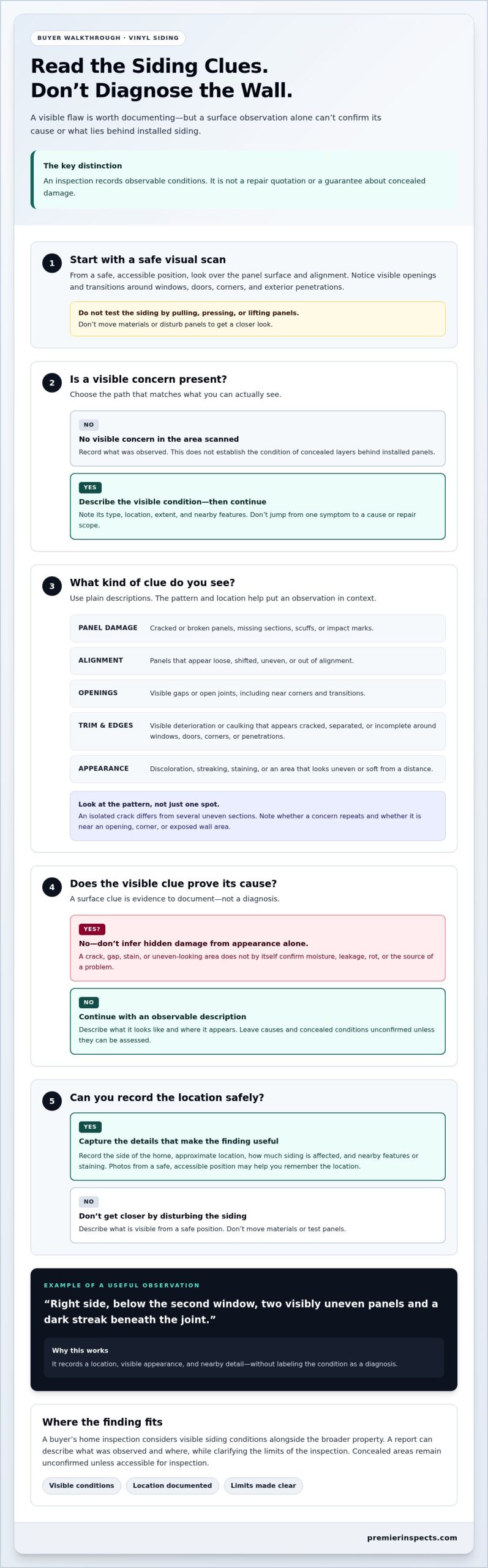
Norfolk Vinyl Siding Inspection Checklist for a Buyer Walkthrough
A ground-level walkthrough can help you organize what you notice before reviewing the home inspection report. It isn’t a substitute for an inspection, and it won’t reveal what installed panels conceal. Keep the process visual and safe: stay on accessible ground, don’t climb, probe, lift, or remove siding, and describe observations rather than calling them confirmed defects.
A safe sequence for recording visible siding conditions
Follow the same sequence around the home so you’re less likely to miss an elevation or jump to conclusions. If an area isn’t safely accessible or visible, note that rather than trying to reach it.
- Take in the overall view. From a safe distance, look at each accessible side of the home. Notice broad changes in alignment, waviness, or surface appearance, and record which elevation you’re viewing.
- Locate visible panel damage. Note cracks, holes, impact marks, or missing sections. Record whether a concern appears isolated or spans multiple panels, without guessing at its cause or the work required.
- Look for displacement and openings. Observe panels that appear loose, shifted, or uneven, along with open joints. Describe their position, such as near a corner or beneath a window.
- Review trim and transitions. From the ground, view the siding around windows, doors, corners, and visible exterior penetrations. Note apparent gaps or separated caulking without touching or testing it.
- Record visible staining. Describe discoloration by its location, shape, and apparent extent. A stain is an observation, not proof of moisture intrusion or a particular underlying condition.
Use brief, factual notes: “Front elevation, below the left window, one cracked panel and a dark streak nearby.” If conditions and access allow, take a photograph from a safe position to help you identify the area later. A clear location and description are more useful than a broad label such as “siding damage.”
How to use findings in your purchase decision
Compare your notes with the inspection report. Look at what the report documents, where the observation is located, and whether visibility or access limited what could be assessed. If you’re preparing for an inspection, the home inspection preparation guidance can help you understand how to get ready and make the most of the process.
Focus your questions on decision-relevant details: Is the concern isolated or present in several areas? Is it near a transition or opening? Was the area accessible to view? These questions help you interpret the record without attempting your own repair diagnosis. A vinyl siding inspection Norfolk buyers can use should document observable conditions within the broader home assessment, not claim certainty about concealed layers.
Keep the distinction clear. A walkthrough helps you notice and describe; the home inspection report provides a documented professional assessment within its scope. Neither makes an inaccessible area visible or establishes what lies behind installed siding.
Book a Norfolk Buyer’s Home Inspection and Get Clearer Siding Findings
Siding is one part of a property’s condition, not the whole story. A buyer’s home inspection puts relevant visible exterior observations alongside findings from other accessible areas of the home, giving you a broader view to consider before making a purchase decision. The purpose is clear documentation of what can be observed, not a siding repair plan or a promise about concealed conditions.
A Premier Home Inspection serves Norfolk and the broader Hampton Roads area, including Chesapeake, Virginia Beach, Portsmouth, Suffolk, and Hampton. Led by Clay Somers, a Certified Master Inspector, the business provides detailed reports to help buyers make informed property decisions.
What buyers can expect from the inspection process
A residential inspection assesses observable conditions within its scope. For siding, visibility and access affect what can be assessed: installed panels conceal underlying materials, and areas that can’t be safely or directly viewed may limit observations. The report documents findings based on what is accessible, helping you distinguish recorded conditions from assumptions about what may be hidden.
Looking for context beyond the exterior? The Hampton Roads home inspection guide for buyers can help you understand how a broader residential inspection fits into the purchase process. Keep the wider perspective in view: an exterior observation matters, but so does how it relates to the property as a whole.
Turn siding observations into a more informed next step
After reviewing the report, consider each siding finding alongside its location, extent, and any access limits noted. A documented crack on one elevation, for example, is a specific observation. It isn’t, by itself, a conclusion about the cause, what lies behind the panel, or what work might be appropriate. Keeping those distinctions clear helps you weigh the evidence without turning an inspection into a repair estimate.
Use the report to organize your property questions and decide what information is relevant to your purchase. A vinyl siding inspection Norfolk buyers receive as part of a home inspection can clarify visible conditions within a larger assessment, while leaving concealed areas unconfirmed unless they are directly accessible for evaluation. That’s a practical foundation for a measured decision, not a guarantee of a particular outcome.
A detailed report gives you findings to review and consider in context. A Premier Home Inspection brings local Hampton Roads inspection experience and professional leadership to that process, so you can approach the property decision with clearer documentation.
Move Forward With a Clearer Property Decision
A home purchase brings choices that extend beyond one exterior feature. Use findings that matter to your priorities to shape your next steps, and keep the distinction between what’s observed and what remains unknown in view. That perspective helps you approach a vinyl siding inspection Norfolk with practical expectations, rather than letting a single visual clue make the decision for you.
A Premier Home Inspection is a veteran-owned Hampton Roads business serving buyers across Chesapeake, Norfolk, Virginia Beach, Portsmouth, Suffolk, and Hampton. The value of an inspection is a professional assessment to inform your property decision, not a diagnosis of concealed conditions or a scope of repair work.
Ready to take the next step toward a more informed purchase? Schedule a buyer’s home inspection that considers the home as a whole.
Make your decision with care and confidence, one well-documented step at a time.
Frequently Asked Questions
Is vinyl siding waterproof?
No. Vinyl siding can help shed rain, but it shouldn’t be treated as a watertight wall covering. Water management also depends on details such as joints, openings, flashing, and the materials behind the siding. For example, rain around a window can interact with the transition between the window and siding. A sound-looking panel surface alone doesn’t establish how the full exterior assembly handles water.
Can a home inspector tell whether there is moisture behind vinyl siding?
A visual home inspection generally can’t confirm moisture behind installed siding. During a vinyl siding inspection Norfolk buyers may see documented signs such as discoloration or a gap, but those observations don’t prove moisture is present or identify its source. An inspector can report visible conditions and note access limits. If further evaluation is warranted, the report can help identify the location or concern that needs attention.
What happens if vinyl siding panels are loose or cracked?
Loose or cracked panels can leave openings or become more displaced, particularly if exposed to wind or other impacts. Note the affected area and extent, then consider the finding in the context of the home inspection report. A single crack doesn’t automatically mean widespread damage or establish a repair plan. Avoid pulling or pressing on a panel to test how firmly it is attached.
How often should vinyl siding be inspected?
There isn’t one interval that suits every home. Include a visual look at siding during routine exterior upkeep, and take another look after a storm or an event that may have affected the building. Pay attention to new changes, such as a panel that appears shifted or a fresh opening near a transition. Keep track of locations over time, but leave climbing or close-up investigation to qualified professionals.
Does a vinyl siding inspection include checking behind the panels?
Usually, no. A standard visual home inspection assesses conditions that are visible and accessible within its scope; it doesn’t involve removing installed siding to expose concealed materials. For homebuyers in Chesapeake, Norfolk, Virginia Beach, Portsmouth, Suffolk, and Hampton, that means a report can document exterior observations without claiming to confirm what’s behind the panels. If a concern remains, use the documented location to guide decisions about further evaluation.
Can damaged vinyl siding mean there is damage to the house?
It can be a reason to look more closely, but damaged siding alone doesn’t prove the house behind it is damaged. For instance, an opening near a window may deserve attention, while a surface scuff may not indicate a deeper concern. The location, extent, and nearby visible conditions help put the observation in context. Use the inspection findings as evidence for a property decision, not as a diagnosis of concealed materials.