

Can a roof leak hide even when your ceiling looks fine? It can, which is why a thermal image may offer a useful clue. If you’re searching for thermal imaging for roof leaks Portsmouth, Virginia, the important question is what the image can actually tell you. Thermal cameras show temperature differences, not water itself, and the same pattern can have more than one explanation.
Before a small concern becomes a bigger one, it helps to understand what thermal imaging can flag, what it cannot confirm, and how to compare an image with visible inspection findings. This article explains how possible roof moisture may appear in a thermal image and how to put those findings in context for a Portsmouth home.
A Premier Home Inspection offers thermal imaging as a specialized residential inspection service. Clay Somers personally conducts every inspection, examining the roof, gutters, and flashing as part of the broader picture. The goal is a clearer understanding of possible concerns, not a promise that an infrared image alone can confirm a leak.
Key Takeaways
- Thermal imaging for roof leaks Portsmouth can flag unusual surface temperature patterns, but an anomaly alone doesn’t confirm a leak.
- Compare thermal patterns with visible observations of the roof, gutters, and flashing to build a clearer picture of possible moisture.
- Record when and where you notice a visible concern, then share those details without assuming its cause.
- Use thermal imaging as an added perspective, not a replacement for a broader residential inspection and professional interpretation.
- In Portsmouth, Virginia, Clay Somers personally conducts each A Premier inspection, providing one inspector and one point of contact.
Can Thermal Imaging Find Roof Leaks in Portsmouth, Virginia?
A roof leak can be present before a Portsmouth homeowner sees a ceiling stain or dripping water. That uncertainty can be stressful when you’re buying a home, preparing to sell, or trying to understand a concern in the home you already own. Thermal imaging can flag unusual temperature patterns that deserve a closer look, but it can’t prove by itself that a roof is leaking.
An infrared camera captures differences in surface temperature. It doesn’t see through shingles, sheathing, or other roofing materials, and it doesn’t show water directly. Instead, it produces an image of temperature patterns across the surfaces in view. The science behind this method is known as Thermography, which is used in building diagnostics as well as other fields.
That distinction matters: an infrared image can direct attention to an area, but it isn’t a leak diagnosis. The pattern needs to be interpreted alongside the home’s condition and other inspection observations.
What a thermal image can indicate about a roof
An infrared camera displays warmer and cooler areas across a visible surface. Under suitable conditions, retained moisture may cool differently from surrounding dry materials, creating a temperature pattern worth investigating. But temperature differences can have other explanations, too. A thermal image can’t establish the cause, confirm roof damage, or tell you by itself whether water has entered the home.
A visible-light photograph records details such as discoloration or damaged materials. A thermal image displays temperature variation instead. Neither image alone provides the full inspection picture. A physical inspection considers visible conditions, including the roof, gutters, and flashing, and places any temperature anomaly in context.
Think of the tools as complementary, not interchangeable. A visible photograph may document a mark, while an infrared image may show a temperature pattern in the same general area. Comparing them can help guide further evaluation, but it doesn’t turn a possible clue into a confirmed leak.
Why Portsmouth, Virginia homeowners search for roof-leak imaging
A suspected roof issue may have no obvious interior symptom, leaving a homeowner unsure whether it needs attention. Buyers may want a clearer view of a home’s condition, sellers may want context before listing, and homeowners may have questions about an area they’ve noticed. In each case, thermal imaging offers another perspective, not a standalone verdict.
For Portsmouth homeowners, the practical value is having thermal imaging considered alongside visible roof observations. Buyers, sellers, and homeowners can use the findings as part of a broader inspection discussion. A temperature anomaly is a reason to look more closely, not a conclusion about the roof. This measured approach helps make an unclear image more useful when assessing the home.
How Thermal Imaging Shows Possible Roof Moisture
A thermal image records surface temperatures. It is not a picture of water inside a roof. The useful question is whether a temperature pattern stands out from the surrounding area and, if it does, what else could explain it. That distinction makes an image an inspection clue rather than an instant diagnosis.
The process is straightforward: capture an infrared image, compare the temperature patterns, then consider unusual areas in context. A cooler or warmer patch is an observation. It doesn’t establish that moisture is present, confirm a roof leak, or identify where water may have entered. The image alone can’t support those conclusions.
From temperature differences to a possible moisture concern
Materials absorb and release heat differently. If moisture is retained in part of a roof assembly, that area may warm or cool differently from nearby dry material under suitable conditions. For example, after a change in surface heating, one patch of roofing might show a different cooling pattern from the surrounding roof. That pattern can flag an area for closer evaluation, but it doesn’t confirm water intrusion.
There’s no universal colour or temperature pattern that proves a leak. The same apparent difference can have another cause, so interpretation matters more than simply identifying a bright or dark patch on the display. An inspector needs to distinguish what the camera records from what the pattern might suggest.
Why an infrared image needs inspection context
Roof materials, sun exposure, and changing environmental conditions can all affect surface temperatures. Different roof sections may heat or cool differently even when there’s no moisture concern. A single image captures one moment, and without context it may be difficult to tell whether an anomaly reflects a roof condition or ordinary temperature variation.
That’s why suspicious patterns should be considered alongside other available observations. Visible roof conditions, including the roof, gutters, and flashing, may provide useful context. Where accessible, attic and interior observations can add another perspective. The aim is to see whether findings support one another, not to make an infrared image carry more meaning than it can.
For someone researching thermal imaging for roof leaks Portsmouth, the practical takeaway is to treat an unusual pattern as a prompt for investigation. Note its location and compare it with related inspection findings. For a Portsmouth home, a broader inspection can bring roof observations together with thermal imaging while keeping the interpretation grounded in the home’s visible conditions.
A Premier Home Inspection offers thermal imaging and evaluates the roof, gutters, and flashing as part of its residential inspection scope. Clay Somers personally conducts every inspection, providing one inspector and one point of contact. Arrange a residential inspection to have potential temperature anomalies considered alongside the broader findings.
Thermal Imaging vs. a Roof Inspection: What Each Can Tell You
A warm or cool patch on an infrared image can catch your attention, but it can’t confirm a roof leak. To understand what the pattern might mean, compare it with visible inspection observations and the condition of related areas. Each approach contributes different information; neither should be asked to establish more than it can show.
| Information source | What it can show | What it can establish |
|---|---|---|
| Visible inspection observations | Observable conditions on the roof, gutters, and flashing | The conditions seen during the inspection, not the full history or cause of a concern |
| Thermal patterns | Differences in surface temperature across areas in view | Whether a temperature pattern may warrant closer assessment, not whether water is present |
| Combined context | How thermal patterns relate to visible observations and other accessible findings | A more informed assessment of observed conditions, without turning an anomaly into proof |
What thermal imaging can add to roof observations
An unusual thermal pattern can help direct attention to a particular area during a broader residential inspection. For example, if a section of a roof displays a different temperature pattern from nearby areas, the inspector can consider it alongside visible observations of the roof, gutters, and flashing. Thermal imaging adds another perspective; it doesn’t replace evaluation of the home’s inspection systems.
That distinction matters for buyers and homeowners alike. A pattern may prompt a closer look, but it doesn’t guarantee that every concealed defect or moisture source will be found. A sound interpretation depends on the available evidence and inspection context, not on the image in isolation.
What it cannot establish on its own
An infrared image isn’t proof of an active leak. It can’t independently identify the source of a temperature difference, establish when a condition began, or determine what repair may be required. Inspection observations document conditions; they aren’t repair or remediation work. A clear report describes what was observed without presenting an unconfirmed cause as fact.
For a buyer, thermal imaging is one input to the overall understanding of a home, not a pass-or-fail result. A Premier’s homebuyer inspection information explains the buyer-focused inspection context. In Portsmouth, a roof concern can be considered alongside observations of the roof, gutters, and flashing, helping buyers distinguish a temperature anomaly from a documented condition.
Searching for thermal imaging for roof leaks Portsmouth? An infrared pattern can guide attention, while inspection context shapes its meaning. Clay Somers personally conducts every inspection, providing one inspector and one point of contact. The result is a more grounded picture of observed conditions, without overstating what a thermal image can prove.
What to Do When Thermal Imaging Flags a Possible Roof Leak
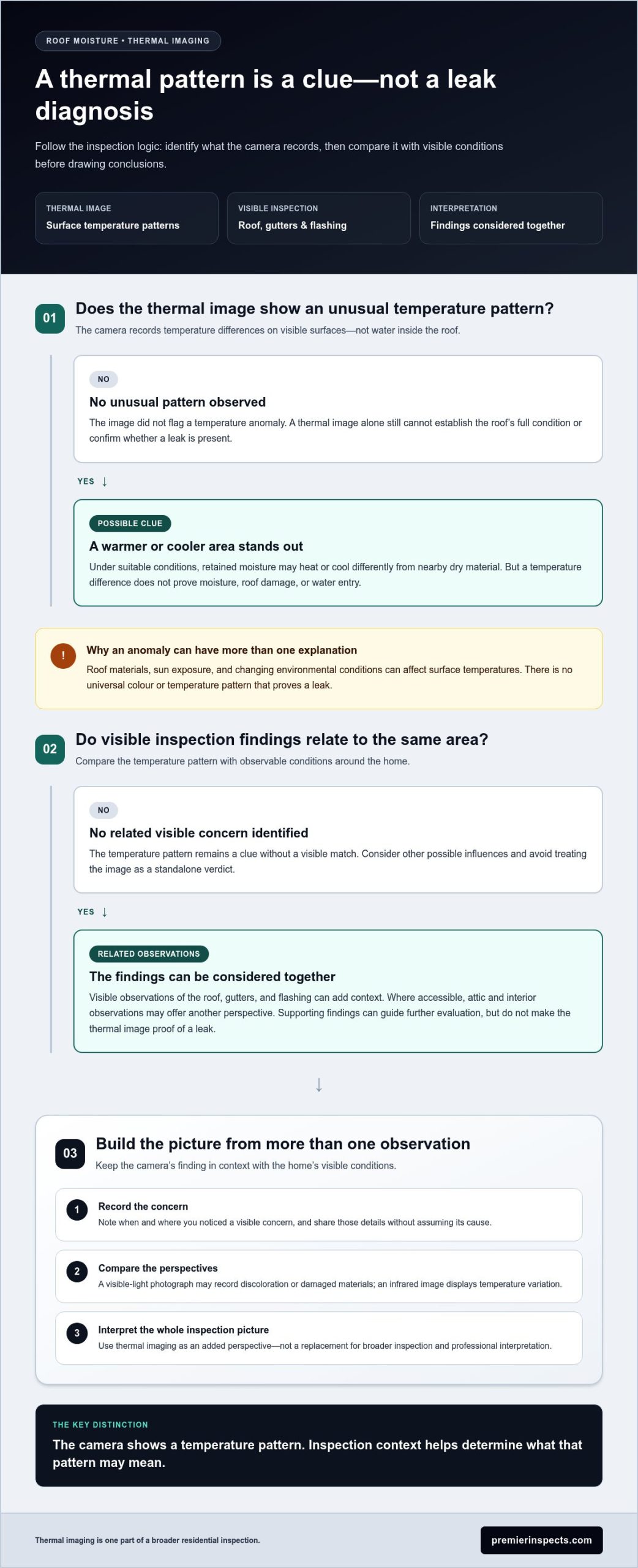
A suspicious thermal pattern is a reason to gather context, not jump to a diagnosis. Use a simple sequence: record the concern, note where the image was taken, compare related inspection observations, and review the documented findings to understand what was observed.
- Note what you’ve seen. Write down where a visible concern appears, such as a ceiling mark, and when you first noticed it. Describe the observation plainly; don’t label it a confirmed roof leak or assume its source.
- Keep the image in context. Note which area the thermal image shows and how it relates to the visible concern. A temperature pattern is one observation, not a diagnosis.
- Consider related findings. Roof, attic, insulation, and ventilation observations may help show whether a thermal anomaly fits with other conditions in the home. No single observation should carry the whole conclusion.
- Use the documented results. Review the inspector’s findings and photos to understand what was observed and where. Keep recorded conditions separate from assumptions about cause or repair.
Prepare useful information for the inspection
Clear notes can help the inspector understand what prompted your concern. Include the location of visible staining or another issue and when you noticed it. If the concern appears under a particular roof area, note that relationship without claiming the roof is the source. Make relevant accessible areas available for the residential inspection, including the attic where it can be accessed. These home inspection preparation tips can help you plan for the visit.
Keep it factual. “A mark appeared on the ceiling near the hallway” is more useful than “the roof is leaking,” unless that cause has been established. Your notes provide context for inspection observations; they don’t replace them.
Read findings without overinterpreting them
A photo-documented report helps you review the inspector’s recorded findings and the areas they relate to. A Premier provides its digital, photo-documented report the same day as the inspection. Read each observation as written, and distinguish what was seen from any possible explanation. A thermal anomaly alone doesn’t identify a leak’s source or determine what repair may be needed.
If the findings raise questions about a possible repair, keep that separate from what the inspection report documents. A home inspection records observed conditions; it isn’t repair or remediation work. For thermal imaging for roof leaks Portsmouth homeowners, buyers, and sellers, this distinction keeps the findings useful: review the report to understand what was observed, not to treat an unconfirmed pattern as a repair diagnosis.
Clay Somers personally conducts each A Premier inspection, providing one inspector and one point of contact for Portsmouth homeowners, buyers, and sellers.
Thermal Imaging for Roof Leaks in Portsmouth with A Premier
A roof concern can leave you wondering what’s happening beyond what you can see. For buyers, sellers, and new-construction homeowners in Portsmouth, a residential inspection can bring roof observations and thermal imaging into a clearer, documented picture. Thermal imaging may flag an unusual temperature pattern, but it doesn’t confirm a leak by itself. Its value comes from interpreting that clue alongside the home’s observable conditions.
A local residential inspection with clear documentation
A Premier Home Inspection serves Portsmouth as part of its Hampton Roads residential service area. The inspection scope includes the roof, gutters, and flashing, and A Premier offers thermal imaging as an additional way to investigate possible temperature anomalies. Those observations can help clarify what drew attention while keeping the limits of an infrared image in view. The image alone can’t guarantee that every leak will be detected or determine a repair solution.
One inspector, one point of contact: Clay Somers personally conducts every inspection. He is a Virginia-licensed home inspector, VA HI #3380001331, NRS, an InterNACHI Certified Master Inspector® (CMI®), and New Residential Structure certified.
After the inspection, you receive a digital, photo-documented report the same day as the inspection. Photos and written observations give you a practical record to review, whether you’re assessing a home before purchase, preparing to sell, or looking at a new-construction home. The report presents documented findings; thermal imaging remains one part of the inspection, not a stand-alone verdict on the roof.
Book an inspection in Portsmouth, Virginia
Portsmouth is among the Hampton Roads communities A Premier serves, alongside Chesapeake, Norfolk, Virginia Beach, Suffolk, and Hampton. For a buyer, seller, or new-construction homeowner, booking an inspection is a practical way to have roof, gutter, and flashing observations considered as part of the home’s broader condition.
If you’re researching thermal imaging for roof leaks Portsmouth, focus on informed findings, not a guarantee from a camera image. Clay Somers personally conducts the inspection, and the same-day digital report keeps the observations together in one place. Inspection pricing depends on the home’s size, age, and any add-on inspections requested. Contact A Premier for a same-day quote.
Move Forward with a Clearer Picture
A roof concern doesn’t have to leave you guessing. Arrange a residential inspection that considers the home as a whole, so you can make decisions with clearer information instead of relying on a thermal pattern alone.
For Portsmouth homeowners, buyers, and sellers, thermal imaging for roof leaks Portsmouth is most useful when it helps frame the right questions about a home’s condition. A Premier Home Inspection brings residential inspection services to the Hampton Roads area, with Clay Somers personally conducting every inspection as a Virginia-licensed home inspector, VA HI #3380001331, NRS, and InterNACHI Certified Master Inspector® (CMI®). You’ll receive a digital, photo-documented report the same day as the inspection. Each inspection is backed by the $25,000 Honor Guarantee, backed by InterNACHI.
Inspection pricing depends on the home’s size, age, and any add-on inspections requested. Contact A Premier for a same-day quote and take the next step toward understanding the home.
A clearer picture starts with a careful inspection and findings you can use.
Frequently Asked Questions
Is thermal imaging accurate for finding roof leaks?
Thermal imaging can help flag a roof area for closer evaluation, but it can’t diagnose a leak on its own. For example, a temperature pattern near a ceiling stain may be worth comparing with visible observations in that part of the home. The pattern alone doesn’t establish that water entered or identify its source. Treat infrared imaging as one investigative tool, with conclusions guided by inspection context and building conditions.
Can thermal imaging see water through a roof?
No. An infrared camera records surface temperatures; it doesn’t look through roofing materials or show water inside them. Moisture may affect how a surface releases heat, so an area could display a pattern that draws attention. Other conditions can also influence temperatures. If you notice a ceiling mark beneath a roof area, that’s useful context to share, not proof that the roof is the source.
How does thermal imaging detect possible roof moisture?
It displays temperature differences across surfaces. Under some conditions, moisture-affected material may cool differently from nearby dry material. The camera records the pattern, not water itself. If an area stands out, its location can help guide further assessment. For instance, an anomaly near a roof section should be considered alongside that section’s visible condition and other relevant findings before drawing conclusions about possible moisture.
What happens if a thermal image shows a possible roof leak?
Use the image as a reason to review the area, not as a final diagnosis. Note where the pattern appears and record any separate visible concern, such as a stain and when you first noticed it. The inspection report can document observed conditions, but it doesn’t provide repairs or remediation. Keep repair decisions separate from the report’s documented findings.
Is thermal imaging included in a home inspection in Portsmouth, VA?
A Premier Home Inspection offers thermal imaging and residential inspections in Portsmouth, Virginia. Clay Somers personally conducts each inspection, providing one inspector and one point of contact. The inspection includes the roof, gutters, and flashing, among other listed systems, and the digital, photo-documented report is provided the same day as the inspection. A Premier serves Hampton Roads communities including Chesapeake, Norfolk, Virginia Beach, Suffolk, and Hampton.
Can thermal imaging find every roof leak?
No. Thermal imaging isn’t a guarantee that every leak or concealed concern will be found. It can help draw attention to a temperature pattern, but results depend on conditions and interpretation. For thermal imaging for roof leaks Portsmouth homeowners, buyers, and sellers, the practical value is an additional perspective for understanding observed conditions. Keep any image in context with the inspection findings, and don’t treat an anomaly as proof of a leak.