

What if the final walkthrough leaves you with questions about your home’s condition just before handover? A builder walkthrough gives you a chance to review the home with the builder. A new construction final inspection Suffolk buyers arrange separately provides a documented visual assessment for their own records. It can help turn observations into focused questions to raise before closing.
It’s reasonable to wonder what an independent inspection covers and how to use the report. This checklist explains the visible systems included in a residential inspection, how to prepare, and how to organize findings for a handover conversation. An inspection describes the home’s visible condition at the time of the visit; it isn’t a technically exhaustive search for concealed defects.
A Premier Home Inspection serves Suffolk and the Hampton Roads communities of Chesapeake, Norfolk, Virginia Beach, Portsmouth, and Hampton. Clay Somers personally conducts each inspection, giving you one inspector and one point of contact. He is a Virginia-licensed home inspector, VA HI #3380001331, NRS. Your digital, photo-documented report is provided the same day as the inspection, so you can review the findings and decide what to discuss with the builder.
Key Takeaways
- A new construction final inspection Suffolk buyers arrange documents the home’s visible condition near handover. Concealed defects aren’t part of a visual assessment.
- Use the checklist to review key areas, from the roof, gutters, and attic to plumbing, electrical systems, HVAC, and interior finishes.
- A builder walkthrough and an independent inspection serve different purposes. Comparing their notes can help you organize clear questions before handover.
- Prepare by coordinating access, attending if practical, then reviewing the report and grouping findings into questions for the builder.
- Keep the 11 Month Inspection in mind as a separate opportunity to document concerns before the builder’s one-year warranty expires.
Why schedule a new construction final inspection in Suffolk before handover?
A newly built home can look finished and still benefit from an independent review. A final inspection is a visual, documented evaluation of accessible residential systems near handover. It records what can be observed during the visit, giving you a clearer basis for questions before you accept the home. It doesn’t certify that the home is defect-free, uncover concealed conditions, or promise that the builder will make repairs.
“New” describes the home’s age, not whether every visible component has been independently evaluated for you. A builder walkthrough and construction approvals have their own purposes; neither provides the same buyer-focused record as a private inspection. In Suffolk, the home’s setting can help you decide what to ask about during the review. A home in a new development, an established neighborhood, or on a larger lot may prompt different questions about visible grading and drainage, exterior siding, or the home’s systems and finishes. The setting alone doesn’t establish a problem. It’s context for a careful review.
What does a new-construction final inspection help a buyer understand?
An inspection creates a practical picture of visible condition, supported by notes and photos. A home inspection generally involves a visual assessment of a home’s condition and the inspector’s findings; the Home inspection overview offers general background on the process. The findings can help you ask specific questions: What does the report note about the roof, gutters, and flashing? Are there visible observations related to plumbing fixtures, electrical panels and wiring, or interior windows and doors? The report doesn’t make the decision for you. It helps you focus the conversation on documented observations instead of relying on memory from the walkthrough.
Clay Somers personally conducts each A Premier Home Inspection visit, and the digital, photo-documented report is provided the same day as the inspection. Use the report to organize follow-up questions while the handover conversation is current. It remains a visual assessment of accessible systems, not a technically exhaustive investigation or a guarantee of a particular outcome.
Is a builder walkthrough the same as an independent inspection?
No. A walkthrough is an opportunity for the buyer and builder to review the home together. An independent inspection is arranged for the buyer and documents visible conditions within the scope of a residential home inspection. Municipal inspections serve a separate building-code and occupancy purpose. A private inspection doesn’t replace municipal requirements or construction approvals; it adds buyer-oriented information for discussion.
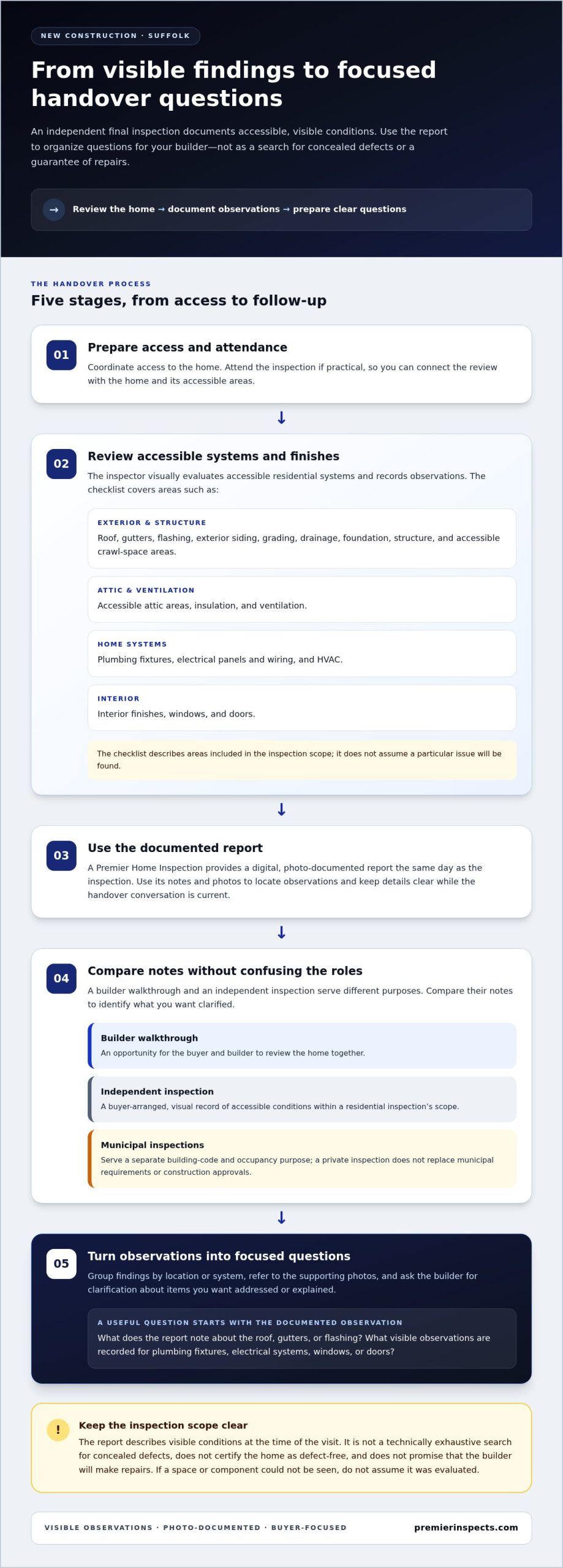
Use the inspection findings as a focused handover tool. Group observations by location or system, refer to the supporting photos, and ask the builder for clarification about items you want addressed or explained. Keep the scope clear: the inspection documents what was visible during the visit. It doesn’t perform repairs, require the builder to take a particular action, or promise a defect-free home.
New construction final inspection checklist: which home systems are examined?
A checklist makes findings easier to connect to questions about your home. During a new construction final inspection Suffolk buyers arrange, the inspector visually evaluates accessible residential systems and documents observations. This isn’t an evaluation of every concealed or inaccessible component. The checklist below reflects the systems included in A Premier Home Inspection’s residential inspection scope, without assuming that a particular issue will be found.
Exterior, roof, attic, foundation, and drainage checklist
As you review these areas, focus on what the report actually documents. Use a note or photo to locate an observation and frame a clear question. Don’t treat it as a diagnosis beyond the inspection findings.
- Roof, gutters, and flashing: Review the documented visible observations and note questions about the condition of these areas.
- Attic, insulation, and ventilation: Look for observations about accessible attic areas, insulation, and ventilation. The report doesn’t represent concealed spaces as inspected.
- Exterior siding, grading, and drainage: Review notes about visible siding conditions and how grading and drainage appear around the home. These observations describe what was accessible to view, not what may be hidden below the surface.
- Foundation, structure, and crawl space: Check the inspector’s documented observations in accessible areas. If a space or component couldn’t be seen, don’t assume the report evaluates it.
For local context, the City of Suffolk’s Suffolk, VA Building Permits and Inspections page covers city permit procedures and inspection requirements. A buyer’s residential inspection serves a different purpose: documenting visible condition for the buyer. The two shouldn’t be confused or treated as substitutes for each other.
Interior, electrical, plumbing, and HVAC checklist
Inside the home, the photo-documented report can help you connect an observation to the system or area noted. That’s useful when you review the findings later or organize questions for the builder. Photos illustrate documented observations; they don’t reveal concealed conditions.
- Electrical panels and wiring: Review visible observations recorded for the panels and wiring within the inspection scope.
- Plumbing supply, drainage, and fixtures: Note findings related to accessible plumbing supply and drainage, along with fixtures. Use the report’s wording to guide follow-up questions.
- HVAC: Review the observations documented for the home’s HVAC system. The report describes inspection findings, not repair work or a promise about future performance.
- Interior walls, ceilings, floors, windows, and doors: Check notes and photos for visible observations about these surfaces and components. Flag anything you want clarified before handover.
Keep the scope in view: an inspection records visible conditions at the time of the visit and doesn’t claim to assess hidden or inaccessible components. To arrange a residential inspection, schedule a new construction inspection with A Premier Home Inspection.
Final inspection versus builder walkthrough: what should Suffolk buyers compare?
A builder walkthrough and an independent inspection may take place around the same point in the homebuying process, but they aren’t the same activity. A walkthrough gives you an opportunity to look over the home and discuss visible concerns with the builder. An independent inspection is arranged for the buyer and produces a separate assessment of the home’s visible condition. For a new construction final inspection Suffolk buyers are considering, the distinction matters: new construction alone doesn’t provide an independent record of what was visible on inspection day.
| Compare | Builder walkthrough | Independent inspection |
|---|---|---|
| Purpose | Review the home with the builder and discuss observations. | Provide the buyer with a visual assessment of accessible residential systems. |
| Documentation | Notes or records may vary with the walkthrough process. | A written, photo-documented report records inspection observations. |
| How it informs questions | Lets you raise concerns as you look through the home. | Helps you organize follow-up questions around documented findings. |
Each activity can help you notice and discuss visible conditions, but they serve different purposes. A walkthrough isn’t automatically a professional inspection, and an inspection doesn’t replace the walkthrough, municipal inspections, or construction approvals. An independent report also doesn’t guarantee repairs, code compliance, or a defect-free home. It documents visible conditions within the inspection scope at that time, giving you a clear reference for the handover conversation.
What a buyer walkthrough can do, and what it cannot document
Use the walkthrough to observe the home and raise concerns you can see. You might, for example, want to discuss a visible condition around a window or door. Walkthrough steps and records can vary, so don’t assume every builder follows an identical process. A written, photo-documented inspection report provides a separate record you can review later and use to frame specific questions.
That distinction is useful when you’re sorting through a lot of new information. Rather than relying only on memory, refer to a photo and its accompanying finding, then ask the builder for clarification. Keep the conversation factual: the report records the inspector’s observations; it doesn’t determine how the builder must respond.
When an 11 Month Inspection fits into the new-home timeline
The final inspection takes place near handover. An 11 Month Inspection is a separate later opportunity to document visible conditions before the builder’s one-year warranty expires. It isn’t a substitute for the handover inspection, and neither inspection guarantees a repair or warranty outcome. Learn more about 11 Month Warranty Inspections as you plan beyond closing.
How to prepare for and use a Suffolk final inspection report
A little preparation helps make the inspection more useful. For a new construction final inspection Suffolk buyers can follow, coordinate timing, arrange access, attend if practical, then review the report and organize questions. The goal isn’t to arrive with a list of assumed defects. It’s to make room for a clear visual assessment and understand what the findings say about the home’s condition.
Most single-family home inspections take two to four hours, depending on the home’s size and age. A Premier’s digital, photo-documented report is provided the same day as the inspection, giving you a record to review as you prepare for handover.
Before inspection day: organize access and buyer questions
When arranging the inspection, share relevant handover timing and property details. Coordinate access for the visit, and note any visible concerns or questions you’ve already observed. Treat them as topics to discuss, not confirmed defects. The home inspection preparation guidance can help you plan what to have in mind.
If practical, attend the inspection so you can follow the observations in context. You don’t need to decide what every finding means on the spot. Note your questions, then use the written report and photos to revisit them.
Use this simple sequence:
- Schedule with handover timing in mind, and share relevant details about the property.
- Coordinate access so the inspection can cover accessible areas within its residential scope.
- Attend if practical, bringing your questions without presuming an issue has been confirmed.
- Review the report and group observations by location or system.
- Organize follow-up questions for the builder or the appropriate transaction contact.
After the inspection: review findings and plan the handover conversation
Start with the written observation, then use its photo to understand the location and visible condition described. Keep the inspector’s wording in view. A photo supports the documented finding; it doesn’t reveal concealed conditions or determine what action another party will take.
Next, sort questions into practical groups. You might ask what an observation describes, whether it has been addressed, or what information is available about it. Discuss relevant findings with the builder or your transaction contacts, referring to the report to keep the conversation specific. The inspection documents condition; it doesn’t perform remediation or promise repairs.
For an independent, photo-documented record to support your handover questions, book your Suffolk new construction inspection.
Book a new construction final inspection in Suffolk with A Premier
Closing on a newly built home is a major decision. A Premier Home Inspection gives new-construction homeowners an independent, documented resource for understanding the home’s visible condition near handover. The aim is practical: help you review inspection findings and bring clear, specific questions to your handover conversation.
There’s one inspector and one point of contact. Clay Somers personally conducts each inspection, so you work directly with the person evaluating the home and preparing the report. Clay is a Virginia-licensed home inspector, VA HI #3380001331, NRS; an InterNACHI Certified Master Inspector® (CMI®); and New Residential Structure certified.
What to expect from A Premier’s inspection
Most single-family home inspections take two to four hours, depending on the home’s size and age. The digital, photo-documented report is provided the same day as the inspection, giving you a written record and images to review as you prepare for handover. It describes visible observations within the inspection scope, not a promise that the home is free of defects or that repairs will be made.
Every inspection is backed by InterNACHI’s $25,000 Honor Guarantee. A Premier’s signature says it plainly: “Anyone Else is Just Looking Around®”. For buyers arranging a new construction final inspection Suffolk homeowners can use to better understand documented findings, that means a personal inspection and a clear report, not a substitute for your own review and questions.
Book your Suffolk inspection and get a same-day quote
Pricing depends on the home’s size, age, and any add-on inspections requested. Contact A Premier for a same-day quote. You’ll have one inspector and one point of contact, and Clay Somers will personally conduct your inspection. As you approach handover, a photo-documented report can help make your questions more focused and your next conversation more informed.
Ready to arrange your inspection? Book your new construction final inspection in Suffolk.
Move toward closing with clear next steps
A new home purchase can feel like a series of decisions made on a tight timeline. Give yourself room to consider what the inspection record means for your handover priorities. An observation is a starting point for a question, not automatically a verdict on the home or a prediction of how it will perform. This distinction can help keep discussions practical and focused on what you want clarified before moving forward.
With a new construction final inspection Suffolk buyers can use to inform their next steps, you don’t need to have every answer at once. Read the findings, note what matters most to you, and decide which questions deserve attention now. Clear information can make the transition from construction to homeownership feel more manageable.
Approach handover with curiosity, ask focused questions, and take your next step with a clear record of the home’s visible condition.
Frequently Asked Questions
Is a final inspection worth it for a new construction home in Suffolk?
It can be worthwhile because a newly completed home is still a major purchase, and buyers benefit from an independent record of visible condition. In Suffolk, use that record to decide which questions matter to you before handover rather than relying only on the home’s newness. An inspection informs your discussion; it doesn’t determine whether to accept the home or guarantee a particular response from the builder.
What does a new construction final inspection check?
It reviews accessible, visible areas of major residential systems, including the roof and attic, exterior and foundation, electrical and plumbing components, HVAC, and interior surfaces, windows, and doors. For example, the report may describe an observable condition at a window or note an observation about plumbing fixtures. It doesn’t establish the condition of concealed or inaccessible components, so use the findings within that visual scope.
When should I schedule a final inspection for a new construction home?
Schedule it near handover, early enough to review the findings and raise questions before your planned acceptance date. Coordinate the visit with your transaction timing and share relevant property details when arranging it. If the builder walkthrough is also on your calendar, keep the activities distinct and allow time to read the inspection report rather than treating the walkthrough as a substitute.
How long does a new construction home inspection take?
Most single-family home inspections take two to four hours, depending on the home’s size and age. The duration varies with the home, so plan for the inspection time and allow a separate opportunity to review the report afterward. That helps keep the visit focused on the inspection rather than rushing through questions.
Does a final inspection replace the builder walkthrough?
No. The walkthrough is an opportunity for you and the builder to look over the home and discuss visible concerns; an independent inspection is a separate buyer-focused evaluation with its own report. Use both for their distinct purposes: the walkthrough for direct discussion, and the report as a written reference when you follow up. Neither guarantees repairs or replaces municipal inspections or approvals.
What happens if the inspection report identifies concerns before closing?
Read the observation and review any accompanying photo to understand what was visible and where. Then group questions by location or system and raise relevant items with the builder or transaction contacts. Ask for clarification or information about next steps; the inspection itself doesn’t decide how an item will be handled. Keep the report as a record of the inspection-day findings.
Is an 11 Month Inspection different from a new construction final inspection?
Yes. A final inspection is timed near handover, while an 11 Month Inspection is a separate later inspection before the builder’s one-year warranty expires. The later visit lets you document visible conditions that have come to your attention during ownership, rather than only those present at handover. Each serves a different point in the timeline; the later inspection doesn’t replace the pre-handover review or promise a warranty outcome.