
What if the credential you notice first tells only part of the story? Choosing an InterNACHI certified inspector Hampton buyers can feel confident in means looking beyond a title to the inspection’s scope, the inspector’s experience, and the usefulness of the final report. A credential is a starting point, not a guarantee that every hidden defect will be found.
It’s reasonable to want reassurance before making one of the biggest purchases of your life, especially when a home’s visible condition may not reveal the full picture. A buyer’s inspection is a decision-support tool, not a pass-or-fail verdict. This guide explains what InterNACHI certification can indicate, what it can’t, and how to compare qualifications and reporting with your transaction deadline in mind.
You’ll also learn what a visual, non-invasive inspection typically covers, how findings can help you prioritize follow-up, and when specialized assessments such as thermal imaging or a sewer scope may be relevant. From Hampton to Chesapeake, Norfolk, Virginia Beach, Portsmouth, and Suffolk, understanding a property’s condition starts with a clear view of what an inspection can and cannot tell you.
Key Takeaways
- Understand what InterNACHI membership and certification can indicate, and why a credential alone doesn’t establish inspection quality.
- Use a practical framework to compare an InterNACHI certified inspector Hampton buyers are considering, including credentials, scope, experience, reporting, and communication.
- Learn which visible, accessible conditions a home inspection can document and which concealed or excluded conditions fall outside its limits.
- Prepare for the inspection by noting property concerns, attending when possible, and using the report to organize follow-up questions and priorities.
- See how a buyer’s inspection from A Premier Home Inspection can support your decision, with detailed reporting from a veteran-owned Hampton Roads business led by Certified Master Inspector Clay Somers.
What InterNACHI certification means when you are buying a home in Hampton
InterNACHI is the International Association of Certified Home Inspectors, a professional association that provides inspector education, testing, certifications, and resources such as its Standards of Practice. For buyers, an InterNACHI credential can signal professional development. It doesn’t promise that an inspection will uncover every defect or that different inspectors will report identical findings.
In brief: InterNACHI certification is an association-issued professional designation with requirements specific to that credential. It is distinct from state licensure and does not guarantee that concealed defects will be found.
InterNACHI membership, training, and certification are not interchangeable
Membership identifies an inspector’s association affiliation. Training is educational, while passing an examination demonstrates performance on that test. A named certification is a specific designation with its own requirements. These terms aren’t interchangeable, and membership alone doesn’t mean an inspector holds every certification offered by the association. InterNACHI’s Standards of Practice set minimum expectations for visual, non-invasive inspections of readily accessible systems in residential properties with up to four units. They explain scope, not identical results.
Virginia licensing is separate. Since July 1, 2017, home inspectors in Virginia must be licensed through the Department of Professional and Occupational Regulation’s Board for Asbestos, Lead, and Home Inspectors. The state’s qualification paths include board-approved education and supervised inspections, and applicants must pass the National Home Inspector Examination. An association credential doesn’t replace a Virginia license.
What Hampton buyers should look for beyond a credential
When comparing an InterNACHI certified inspector Hampton buyers are considering, look at the practical details behind the designation:
- Scope: Review which systems and components the inspection covers, along with access requirements and limitations.
- Relevant experience: Consider familiarity with the home’s age and features. In older Hampton-area homes, for example, buyers may encounter systems such as knob-and-tube wiring.
- Reporting: Look for clear descriptions and useful photos that help you understand observed conditions and prioritize follow-up.
- Communication: Consider whether the inspection process gives you a practical opportunity to understand findings and raise questions.
No credential can make concealed conditions visible during a standard visual inspection. A sound choice combines verifiable qualifications with a clear scope, relevant experience, and a report you can use. For broader context on local inspections, read the Complete Guide to Home Inspection in Chesapeake & Hampton Roads (2026).
How to evaluate an InterNACHI-certified inspector before booking
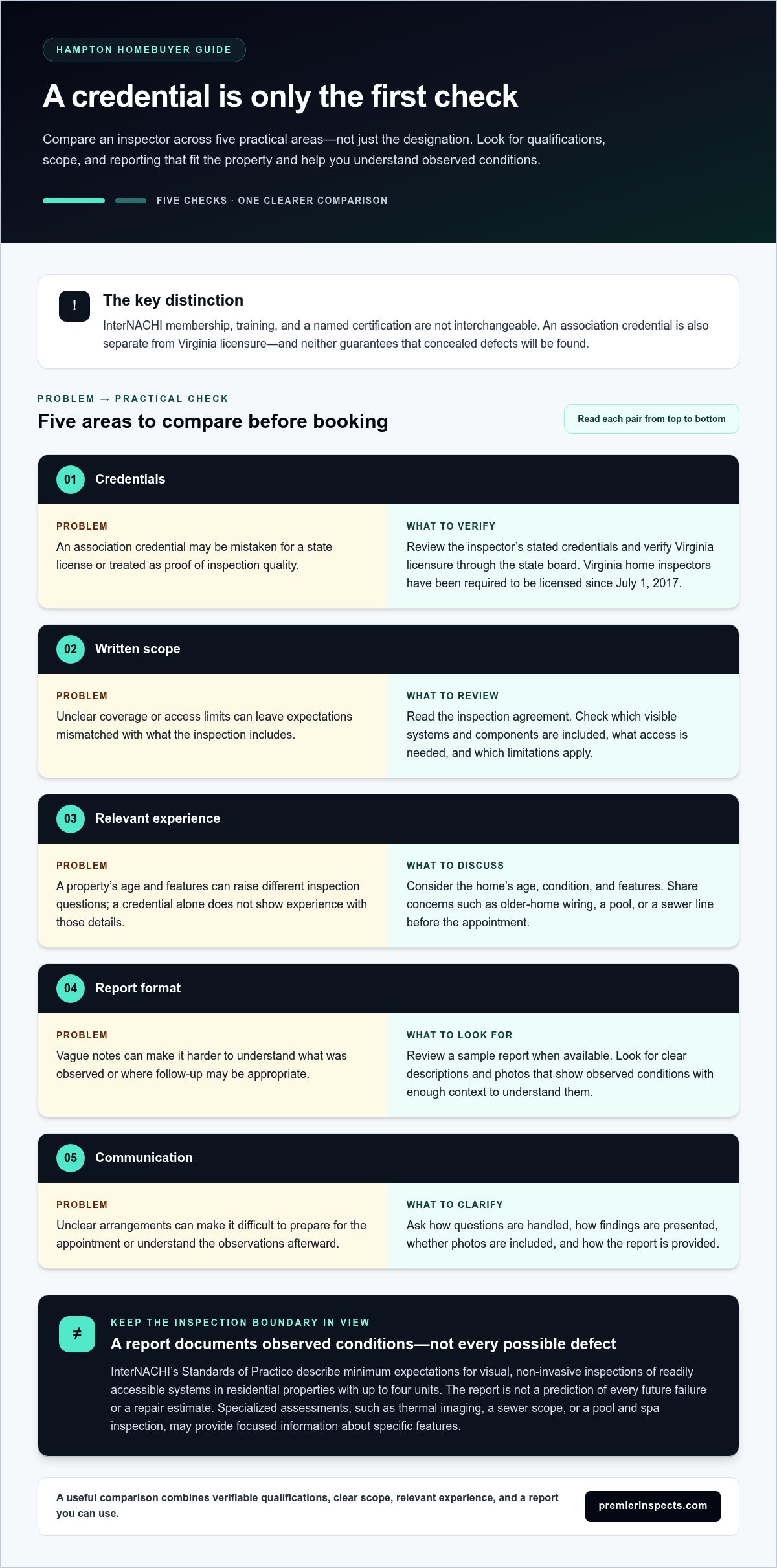
A useful comparison goes beyond a credential. Use this five-point framework to determine whether the inspection fits the property and whether its findings will help you make informed decisions.
- 1. Credentials: Review the inspector’s stated credentials and verify Virginia licensure through the Virginia Board for Asbestos, Lead, and Home Inspectors. Association certifications and state licensing are separate qualifications.
- 2. Written scope: Read the inspection agreement before booking. Check which visible systems and components are included, what access is needed, and which limitations apply. A clear scope helps set expectations.
- 3. Relevant experience: Consider the property’s age, condition, and features. An older home, a property with a pool, or a house with a sewer line may prompt different inspection questions than a newer home without those features.
- 4. Report format: Review a sample report when available. Look for clear descriptions and photos that show observed conditions, with enough context to understand where follow-up may be appropriate. A useful report helps you sort findings instead of leaving you to interpret vague notes.
- 5. Communication: Understand how questions are handled and how the report is provided. Clear communication can help you prepare for the appointment and understand the observations afterward.
Questions that reveal scope and reporting quality
Clarify which major visible systems the buyer’s inspection covers, how findings are presented, whether photos are included, and how the report is provided. An inspector reports conditions observed during the inspection; the report isn’t a prediction of every future failure or a repair estimate. These details help you understand what the service can inform and where its limits are.
Match experience and inspection options to the property
Share property-specific concerns before the appointment, such as signs of moisture, visible features of an older home, or the presence of a pool. Thermal imaging may help assess certain temperature patterns, while a sewer scope or pool and spa inspection can provide focused information about those features. These are specialized assessments to consider based on the property, not assumptions about what every home needs.
For another preparation resource, see this home inspection preparation guide. When you’re ready to arrange a buyer’s inspection, schedule your Hampton-area inspection with A Premier Home Inspection.
What a Hampton home inspection can tell you, and what it cannot
A buyer’s home inspection is a visual assessment of readily accessible components. It documents conditions the inspector observes on the inspection day, but it isn’t a guarantee, a technically exhaustive investigation, or a repair estimate. The InterNACHI Standards of Practice describe the general scope and limitations of this type of inspection.
| What an inspection may report | What it cannot establish |
|---|---|
| Visible, accessible conditions in systems such as roofing, structure, plumbing, electrical, heating, and cooling | Concealed or latent defects behind walls, beneath floors, or in otherwise inaccessible areas |
| Observed signs of damage, wear, moisture, or drainage concerns at the time of inspection | Every future failure, a component’s exact remaining service life, or the cause of a condition requiring further evaluation |
| Conditions that can be seen in accessible areas, subject to the agreed inspection scope | Market value, insurability, suitability for a particular use, or a detailed repair estimate |
Visible components and property-specific observations
The inspector generally reviews accessible parts of the roof, exterior, foundation and structure, plumbing, electrical, and HVAC systems. That may include looking for visible roof wear, checking accessible plumbing fixtures, and observing exterior surfaces. Stored belongings, locked areas, occupancy, weather, and other site conditions can limit access, so an obstructed area may not be fully observed.
For a Hampton-area property, note visible roof wear, grading and drainage, and signs of moisture. For example, water staining near a ceiling or soil sloping toward a foundation may warrant documentation and follow-up. These are conditions to assess at the individual home, not assumptions that every local property has a defect.
Inspection findings support a buyer’s decisions; they don’t replace specialist evaluation when a condition needs deeper investigation. A report can identify an observed concern and help you decide what follow-up may be appropriate, but it doesn’t diagnose every underlying cause or predict how a system will perform in the future.
When a specialized assessment may add useful information
Some properties and buyer concerns call for a closer look at a particular feature. A sewer scope can provide information about accessible portions of a drain line, complementing observations from the general inspection. Thermal imaging may reveal temperature patterns that warrant attention, but it isn’t a stand-alone diagnosis and doesn’t see through walls. If the property has a pool or spa, a focused assessment can provide relevant observations about those features. Consider the home’s characteristics and your concerns when deciding which assessments fit.
A credential can help guide your choice, but the value of an InterNACHI certified inspector Hampton buyers select also depends on a clear account of observed conditions, access limitations, and practical next steps.
From inspection appointment to report: prepare for a Hampton-area purchase
Preparation helps you get more value from the inspection and use the findings within your transaction timeline. Start by sharing known concerns and relevant property details. Attend if practical, review the report promptly, and organize follow-up questions and priorities. Keep your real estate transaction timeline in view so you understand when the inspection information is needed under your contract.
Before and during the inspection
Before the appointment, note concerns you’ve noticed, such as water staining, a sticking door, or an unusual sound from a system. Share questions about the home’s features and any areas you especially want to understand. This gives the inspector useful context while keeping the inspection focused on observed conditions and the agreed scope.
If you can attend, you may be able to see findings in context and ask questions as the inspector moves through accessible areas. Bring a short list so important concerns don’t get lost in the moment. For more preparation tips, read the home inspection preparation guide.
Turn report findings into informed next steps
The report documents conditions observed during the inspection. Use it as a decision-support tool, not a pass-or-fail verdict. As you review it, sort findings into practical groups: potential safety concerns, significant defects, routine maintenance, and items recommended for further evaluation. This helps you identify which questions may need timely attention and which findings can inform future planning.
Some findings need a closer diagnosis. The report can describe the observed condition, but further evaluation may require a qualified specialist with expertise beyond the inspection’s scope. Keep a record of those recommendations and coordinate follow-up with your transaction timeline. A Hampton buyer’s inspection should help you understand the home’s visible condition and make informed decisions, not promise that every concealed issue has been ruled out.
A Premier Home Inspection provides buyer’s inspections in Hampton and the surrounding Hampton Roads area. When comparing an InterNACHI certified inspector Hampton buyers might book, consider clear reporting and an inspection process that helps you understand findings and plan next steps. Buyers looking for a related service-area resource can also review Virginia Beach buyer’s inspections.
Book a buyer’s inspection in Hampton with A Premier Home Inspection
Choosing an inspector is about more than finding a credential. You need a clear view of a home’s observed condition before making a major investment. A Premier Home Inspection is a veteran-owned and operated Hampton Roads business serving Hampton and nearby communities, with buyer’s inspections that give purchasers useful information for decision-making.
A buyer-focused inspection led by an experienced local professional
Clay Somers is a Certified Master Inspector. That credential is distinct from an InterNACHI certification. When searching for an InterNACHI certified inspector Hampton buyers can book, distinguish association credentials from other professional qualifications and consider the inspection scope and reporting approach as well.
A buyer’s inspection isn’t meant to label a property simply “good” or “bad.” It documents observed conditions so you can better understand the home and plan appropriate follow-up. A detailed report organizes findings and explains why they may matter, giving you a practical reference as you consider the purchase.
Some properties raise questions that call for focused assessments. Depending on the home and your concerns, thermal imaging, a sewer scope, or a pool and spa inspection may add relevant information. A Premier Home Inspection also provides free RecallCHEK services. These services can support your understanding of specific features, but they don’t guarantee that every hidden condition will be found or prevent future repairs.
Choose a clear next step for your home purchase
As you coordinate your inspection, keep your purchase timeline in view. Share property-specific concerns and questions ahead of the appointment so they can inform the inspection process. Once you receive the report, use its descriptions of observed conditions to identify items for follow-up and organize next steps. The findings are there to inform your decision, not make it for you.
For Hampton buyers, working with a local Hampton Roads inspector means choosing a service based in the area during a time-sensitive purchase. Clear reporting and relevant assessment options can help turn uncertainty into a more informed plan.
Make your Hampton home purchase with greater confidence
An InterNACHI credential can be one useful point of comparison, but it shouldn’t be the only one. Review the inspector’s license and qualifications, written scope, relevant experience, and report quality. A buyer’s inspection documents observed conditions; it supports your decisions but can’t guarantee that concealed issues will be found.
A Premier Home Inspection is a veteran-owned and operated Hampton Roads business led by Clay Somers, a Certified Master Inspector. Detailed reports help buyers understand findings and plan follow-up. Free RecallCHEK services and optional assessments, including thermal imaging, sewer scopes, and pool and spa inspections, can add useful information when relevant to the property. The Certified Master Inspector credential is distinct from an InterNACHI credential.
Choose an InterNACHI certified inspector Hampton buyers can evaluate by looking at the full picture, then schedule your buyer’s inspection with your transaction timeline in mind. Clear findings can help you take the next step with a stronger understanding of the home.
With practical information in hand, you can move forward with greater confidence in your home-buying decision.
Frequently Asked Questions
What does InterNACHI certification mean for a home inspector?
InterNACHI certification is a professional credential issued by the International Association of Certified Home Inspectors for inspectors who meet the requirements of a particular designation. It’s distinct from association membership, and requirements can vary by credential. The association’s Standards of Practice describe minimum expectations for a visual inspection, but certification doesn’t guarantee identical results or that concealed defects will be discovered.
Is an InterNACHI-certified inspector also licensed in Virginia?
No. InterNACHI credentials and Virginia home-inspector licensure are separate. Virginia requires home inspectors to hold a state license, regulated by the Department of Professional and Occupational Regulation’s Board for Asbestos, Lead, and Home Inspectors. An association certification doesn’t replace that license. If you’re buying in Hampton, review an inspector’s Virginia license separately from any professional association membership or certification.
What should a buyer’s home inspection in Hampton include?
A buyer’s inspection generally covers visible, accessible systems and components within the written scope, such as the roof, exterior, structure, plumbing, electrical, heating, and cooling systems. It may also address accessible interior areas, windows, doors, and attic components. Review the written scope to see what’s included and understand access limitations. Specialized assessments, such as a sewer scope or pool and spa inspection, focus on specific features.
Can I attend my home inspection in Hampton?
Attending can help you see observed conditions in context and better understand the report. Plan for attendance when arranging the inspection, and prepare questions about visible concerns, major systems, or features such as a pool. The inspection report remains an important written record, so review it even if you attend. Findings document conditions observed during the visit; they aren’t a guarantee that every defect has been found.
How do I compare InterNACHI-certified inspectors?
Compare the specific credentials, Virginia license, written inspection scope, experience with similar properties, report clarity, and communication. A sample report can show whether findings are described clearly and supported with useful photos. To choose an InterNACHI certified inspector Hampton buyers can evaluate confidently, consider the complete service, not just the credential. A Premier Home Inspection serves Hampton, Chesapeake, Norfolk, Virginia Beach, Portsmouth, and Suffolk; Clay Somers is a Certified Master Inspector, a distinct credential.
Does a home inspection guarantee that a Hampton house has no problems?
No. A home inspection is a visual, non-invasive assessment of readily accessible components, not a guarantee or a technically exhaustive investigation. Concealed conditions may not be visible, and the inspection doesn’t predict every future system failure or provide a repair estimate. The report can document observed concerns and help you decide what follow-up may be useful, including specialist evaluation when a condition needs further diagnosis.
When should I schedule a buyer’s home inspection?
Schedule as soon as practical after your offer is accepted, while keeping your purchase contract and inspection contingency dates in view. There isn’t one universal deadline for every transaction, so coordinate the appointment with the timeline that applies to your purchase. Share property-specific concerns when arranging the inspection, then allow time to receive and review the report and consider recommended follow-up before relevant contract dates.