
Searching “crawlspace encapsulation inspection Portsmouth” often starts with a practical question: what can an inspection tell you about a crawl space before you decide what to do about the property? A clear inspection record helps you consider observed conditions rather than relying on a label such as “encapsulated” or “needs encapsulation.”
A buyer’s home inspection documents the crawl space as part of the home, alongside the foundation and structure. In Portsmouth, moisture concerns can make these observations especially relevant when weighing a property. An inspection reports observed conditions; it is not an encapsulation installation or a repair-design assessment, and it does not determine code compliance.
A Premier Home Inspection includes the crawl space, foundation, and structure in its residential inspections. Clay Somers personally conducts each inspection, and you receive a same-day, photo-documented digital report to review as you consider the property. This guide explains what an inspection can reveal, how to use its findings alongside a separate project proposal, and what to expect when booking in Portsmouth, Virginia.
Key Takeaways
- A crawlspace encapsulation inspection Portsmouth buyers can use documents observed crawl-space conditions to inform a property decision.
- Inspection findings and a project proposal serve different purposes. Compare the proposal with the report without treating one as proof of the other’s assumptions.
- Prepare by listing your property questions and gathering any information you want to review during the appointment.
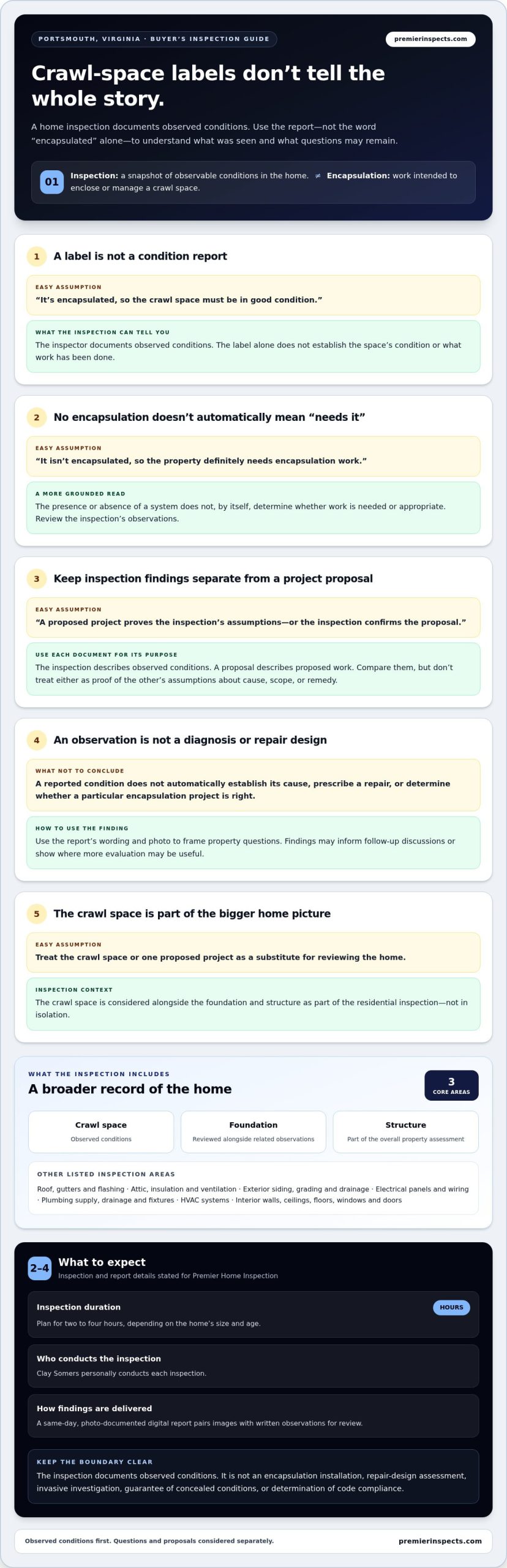
- Plan for an inspection lasting two to four hours, depending on the home’s size and age.
- Clay Somers personally conducts each inspection, and the digital, photo-documented report is provided the same day as the inspection.
What Does a Crawl Space Encapsulation Inspection in Portsmouth, VA Help You Understand?
A crawlspace encapsulation inspection Portsmouth buyers can use is an evaluation of the crawl space as part of a residential home inspection. Its purpose is to document observed conditions, not to sell or install an encapsulation system. That distinction matters: an inspection gives you information about the home as it stands, while encapsulation work changes the crawl space.
For a buyer, this information makes an often-unseen area part of the property review. You can consider the report’s observations alongside those about the foundation and structure, then decide what questions matter to your purchase. Findings may inform follow-up discussions or show where more evaluation may be useful. They do not, by themselves, establish the cause of a condition, specify a repair, or determine whether a particular encapsulation project is appropriate.
What does crawl-space encapsulation mean in this context?
Here, “encapsulation” refers broadly to work intended to enclose or manage a crawl space. The term alone does not tell you what work has been done or what a property might need. A home inspection provides a snapshot of observable conditions; it is not an installation, repair, or project design. For general background on crawl-space uses and designs, see this overview of the crawl space.
This distinction helps keep a property decision grounded in documented information. A buyer may hear “encapsulated” and assume the space is in good condition, or see an unencapsulated space and assume work is automatically required. Neither conclusion follows from the label alone. The inspection’s observations offer a more useful starting point than the presence or absence of an encapsulation system.
Why does the crawl space matter when evaluating a home?
The crawl space is part of the home, not an optional footnote. A Premier’s residential home inspections include the crawl space, foundation, and structure, so you can review related observations as part of the overall property assessment. In Portsmouth, Virginia, that context helps you understand what the report says about the home you are considering.
Clear documentation also helps you organize next steps. If the report notes an observed condition, use the specific wording and photo to frame questions about the property or compare the finding with a separate proposal. Keep the records distinct: the inspection describes observed conditions, while a proposal describes proposed work. One does not automatically prove the other’s assumptions about cause, scope, or remedy.
A Premier provides a same-day, photo-documented digital report, giving you images and written observations to review as you weigh the property. The goal is clarity, not a predetermined conclusion about encapsulation. A careful crawl-space inspection helps you understand what was observed, identify what remains uncertain, and make your next decision with better information.
What Does a Home Inspection Cover Around Crawl-Space Encapsulation?
Encapsulation may be part of a home’s history or a buyer’s questions, but the inspection has a broader job: document the home’s condition within its residential scope. It gives you an organized account of what the inspector observes, rather than a sales proposal for an encapsulation system. That distinction helps you keep property findings separate from decisions about future work.
Every A Premier home inspection includes the crawl space, foundation, and structure. These areas are considered as parts of the same home, so you can review crawl-space observations alongside findings about the foundation and structure. For a crawlspace encapsulation inspection Portsmouth buyers can use when making a property decision, this scope provides a useful starting point: the goal is to understand observed conditions, not to prescribe an encapsulation project.
How the crawl space fits into the inspection scope
A crawl-space evaluation belongs within the larger residential inspection, not in isolation. The inspector considers the crawl space in relation to the foundation and structure, then records relevant observations in the report. This gives you context for reviewing the home while keeping the findings within the inspection’s scope. It is not an invasive investigation or a guarantee that concealed conditions will be found.
That boundary matters. A home inspection documents conditions the inspector observes; it does not establish every hidden condition or turn an observation into a definitive diagnosis. If the report identifies something you want to understand further, use the documented finding to guide your property review. A proposed encapsulation plan is a separate document with a different purpose.
The inspection also covers other listed areas of the home, including the roof, gutters, and flashing; attic, insulation, and ventilation; exterior siding, grading, and drainage; electrical panels and wiring; plumbing supply, drainage, and fixtures; HVAC systems; and interior walls, ceilings, floors, windows, and doors. Reviewing the crawl space alongside these systems gives you a broader record of the home rather than treating one proposed project as a substitute for an inspection.
How the report helps make findings understandable
A Premier’s digital report is photo-documented and provided the same day as the inspection. Photos paired with written notes help you revisit an observation after the appointment, locate the area it refers to, and consider it more clearly as part of your property decision. The report records findings; it does not design a remedy or perform repair or remediation work.
For example, if a report documents a crawl-space observation, refer to its description and supporting photo when reviewing the property or a separate proposal. Keep the questions distinct: What was observed? What work does the proposal describe? How does that proposed scope relate to the documented condition? This approach helps prevent assumptions about cause or scope from being mistaken for inspection findings.
Clay Somers personally conducts each inspection, giving you one inspector and one point of contact. If you are ready to arrange a residential inspection that includes the crawl space, foundation, and structure, you can book a Portsmouth home inspection.
How Should You Use Encapsulation Inspection Findings When Comparing Options?
An inspection report and an encapsulation proposal answer different questions. The report documents observed property conditions within the home-inspection scope. A proposal describes work someone recommends or plans to perform. Comparing the two can help you identify what the inspection documents, what work is proposed, and what remains unclear. Neither document guarantees a particular outcome for the property.
For a crawlspace encapsulation inspection Portsmouth buyers can use effectively, start with the report’s actual wording and photos. Do not treat a proposed solution as proof of the cause, or assume that an inspection observation automatically means a specific project is needed. Keep the records side by side, but read each for its own purpose.
Inspection findings versus an encapsulation project proposal
A report describes observations made during a residential home inspection. A project proposal focuses on suggested work and its planned scope. The report is not an installation assessment, and the proposal is not a substitute for an independent record of the home’s observed condition. Keeping those roles separate helps you evaluate the property without confusing a recommendation with an inspection finding.
| Document | Main purpose | How to use it |
|---|---|---|
| Home inspection report | Records observed conditions within the inspection scope. | Locate the relevant note and photo, then consider what they tell you about the property. |
| Encapsulation or repair proposal | Describes work being proposed for the crawl space. | Review the proposed scope separately and compare it with the report’s documented observations. |
For example, if a report includes a crawl-space observation and a separate proposal recommends work, note whether the proposal addresses that documented observation. The comparison can help you frame a follow-up discussion, but it does not establish that the observation caused the proposed work or that the proposal is the only possible response.
What questions can the report help you frame?
Use specific report notes to shape your questions. Start with what the inspector recorded, not a technical conclusion you have inferred. You might ask:
- Which report note or photograph relates to the crawl-space concern I am reviewing?
- What does the report describe as observed, and what remains an assumption about cause?
- Does the proposed work address the documented observation, or does it cover a broader scope?
- What additional information would help me evaluate this point before making a property decision?
These questions can help you organize a conversation about the property and keep the focus on evidence rather than labels such as “encapsulated” or “needs encapsulation.” A report can inform your decision, but it cannot decide whether to buy, establish the full scope of future work, or promise how the home will perform.
If you are weighing crawl-space findings alongside other parts of a property review, use the broader inspection context to keep each observation in perspective. The report is a record of what was observed; any separate proposal should be considered on its own terms.
How to Prepare for a Crawl-Space Inspection in Portsmouth
A little preparation can help you get more value from your inspection appointment. For a crawlspace encapsulation inspection Portsmouth buyers can approach with clear questions, focus on what you want to understand about the home rather than trying to diagnose the crawl space in advance. The inspection includes the crawl space, foundation, and structure, so your questions can connect these areas to the property decision you are making.
What to have ready before the appointment
Before the inspection, write down the crawl-space questions that matter most to you. If you are considering encapsulation, note whether you want to understand existing conditions, review a feature mentioned in the property information, or make sense of a separate proposal. Keep your questions tied to what you know about the home instead of assuming what the space needs.
A simple preparation sequence can keep your priorities clear:
- Write down your main questions about the crawl space, foundation, and structure.
- Gather any property information or proposal documents you want to review in relation to those questions.
- Keep your notes available for the appointment so you can refer to them as needed.
You do not need technical expertise to prepare. Clear questions help you focus on the observations that matter to your purchase decision. For additional practical steps before an appointment, use this home inspection preparation guidance.
What to expect from the inspection and report
Plan for the inspection to take two to four hours, depending on the home’s size and age. Clay Somers personally conducts each A Premier inspection, so you have one inspector and one point of contact. The crawl space is considered as part of the residential inspection alongside the foundation and structure.
You will receive a digital, photo-documented report the same day as the inspection. Set aside time to review the notes and images while your questions are fresh. If a report observation relates to a concern you listed beforehand, use its wording and photo to keep any follow-up discussion specific. The report documents observations; it does not prescribe repair work or design an encapsulation system.
Preparation is most useful when it helps you distinguish what you want to know from what the inspection can document. Bring your property questions, note which observations you want to review, and use the report as a record for your decision-making. That gives you a clear starting point without assuming in advance what the crawl space requires.
Book a Portsmouth Home Inspection That Includes the Crawl Space
A property decision is easier to approach when you have a clear record of the home’s condition. A Premier Home Inspection serves Portsmouth, Virginia, with residential inspections that include the crawl space, foundation, and structure. If you are looking for a crawlspace encapsulation inspection Portsmouth buyers can use to understand observed conditions, this inspection provides a documented starting point, not an installation pitch.
Why A Premier’s inspection approach supports clear decisions
Clay Somers personally conducts every inspection, so you work with one inspector and one point of contact. He is a Virginia-licensed home inspector, VA HI #3380001331, NRS, and holds InterNACHI Certified Master Inspector® (CMI®) status. Each inspection includes a same-day, photo-documented digital report, helping you review observations as you consider the property and your next steps.
Every inspection is backed by InterNACHI’s $25,000 Honor Guarantee. The inspection documents observed conditions within its residential scope. It does not install an encapsulation system or replace a separate project proposal. That distinction keeps the report useful as a record while you consider the home and any proposed work.
Photos and notes can help you return to a specific observation rather than relying on memory. Use them to organize questions about the crawl space, foundation, or structure and share relevant details during a property discussion. The findings can inform your decision, but they do not promise a particular outcome or determine whether a proposed project is the right choice.
How to book in Portsmouth, Virginia
A Premier serves Chesapeake, Norfolk, Virginia Beach, Portsmouth, Suffolk, and Hampton, as well as Newport News, Williamsburg, Yorktown, Franklin, and Windsor. If you are evaluating a home in Portsmouth or one of these Hampton Roads communities, choose a residential inspection for the property and use the report to review its documented observations.
Inspection pricing depends on the home’s size, age, and any add-on inspections. Contact A Premier for a same-day quote. The inspection takes two to four hours, depending on the home’s size and age, and Clay Somers personally conducts each inspection. You will receive the digital, photo-documented report the same day as the inspection.
For buyers weighing crawl-space conditions alongside the rest of a home, a documented inspection offers a grounded place to begin. Book your Portsmouth home inspection to review the property with a clear scope and one point of contact.
Make Your Next Property Decision With Clarity
A crawlspace encapsulation inspection Portsmouth buyers can use is a practical first step toward replacing uncertainty with a clearer picture of the home. As you consider what comes next, keep inspection observations separate from assumptions about what work may be needed. Let documented findings guide your questions, then weigh the answers alongside your priorities for the property.
With A Premier, Clay Somers personally conducts every inspection, giving you one inspector and one point of contact. Your same-day, photo-documented digital report provides a record to revisit as you consider the home, and each inspection is backed by InterNACHI’s $25,000 Honor Guarantee.
Take the next step with a focused inspection and a clearer basis for your decision.
Your home decision deserves careful attention. Move forward with confidence, one well-documented finding at a time.
Frequently Asked Questions
Is the crawl space included in an A Premier home inspection?
Yes. Every A Premier residential home inspection includes the crawl space, foundation, and structure. If you are reviewing a home with an encapsulation system, note questions about its visible condition and refer to the relevant report observations afterward. The inspection documents the home’s observed condition; it does not install an encapsulation system or assess an encapsulation project. This distinction helps you understand what the inspection contributes to your property review.
How long does a home inspection take in Portsmouth?
A home inspection takes two to four hours, depending on the home’s size and age. If you are coordinating the appointment with a home purchase, allow for that range when arranging your day. Keep your property questions organized, especially if you want to review observations related to the crawl space, foundation, or structure. The findings are documented in the report for review after the appointment.
How much does a crawl-space encapsulation inspection cost in Portsmouth?
The cost of a home inspection depends on the home’s size, age, and any add-on inspections. Contact A Premier for a same-day quote; the company does not publish a fixed inspection price. An inspection documents observed property conditions; it is not the cost of installing an encapsulation system. Keep the cost and purpose of an inspection distinct from those of any separate work proposal.
Can a home inspection help before a crawl-space encapsulation decision?
Yes. A crawlspace encapsulation inspection Portsmouth buyers arrange as part of a residential home inspection can document observed conditions to inform their decision. For instance, if you are reviewing a proposal that mentions a crawl-space concern, compare its description with the report’s relevant notes and photos. The inspection can help you frame follow-up questions, but it does not determine the cause of a condition or prescribe a specific project.
When will I receive the inspection report?
You will receive the digital, photo-documented report the same day as the inspection. The photos and written notes make it easier to locate a particular observation when you review the property information or discuss a finding as part of your purchase. To keep your review focused, note the report items you want to revisit and refer to their descriptions rather than relying on memory alone.
Does A Premier serve Portsmouth, Virginia?
Yes. A Premier Home Inspection serves Portsmouth, Virginia, as part of its Hampton Roads service area. If you are buying a Portsmouth property, the residential inspection provides documented observations to consider as part of your evaluation. Have the property address ready when arranging an appointment so the booking details are tied to the home you are considering.
Who conducts the home inspection?
Clay Somers personally conducts every A Premier home inspection, so you have one inspector and one point of contact. He is a Virginia-licensed home inspector, VA HI #3380001331, NRS, and an InterNACHI Certified Master Inspector® (CMI®). His personal inspection and the documented report give you a clear reference when reviewing the property’s findings.