
Could an inspection that checks four major systems still leave important questions about a home unanswered? Yes. A four-point inspection focuses on the roof, electrical, plumbing, and HVAC systems, often for an insurance review. A pre-purchase home inspection Virginia Beach buyers arrange serves a broader purpose: helping them understand the property before they commit.
It’s understandable to wonder whether a four-point report could affect your insurance or transaction, and whether it’s enough to judge a home’s condition. The key is understanding that a four-point inspection is limited. It isn’t a substitute for a full buyer’s inspection, because each serves a different need.
This guide explains what a four-point inspection typically reviews, what it leaves out, and how it differs from a buyer’s home inspection. You’ll also learn how to prepare useful property information and choose an inspection that fits your immediate decision. A Premier Home Inspection serves buyers in Virginia Beach, Chesapeake, Norfolk, Portsmouth, Suffolk, and Hampton with detailed reporting to support informed property decisions.
Key Takeaways
- Learn why insurers may request a four-point report and why requirements can vary by carrier and property.
- See what an inspector can assess through visible, accessible conditions in the roof, electrical, plumbing, and HVAC systems.
- Compare a four-point review with a full buyer’s inspection to match the inspection to your immediate need.
- Prepare by confirming the requested scope, gathering available system and maintenance records, and arranging access.
- Use a pre-purchase home inspection Virginia Beach buyers can rely on to gain a broader understanding of the property, supported by detailed reporting.
What a Four Point Inspection in Virginia Beach Is, and Why It’s Requested
A four-point inspection is a focused review of four major home systems: the roof, electrical, plumbing, and heating or cooling systems. It records observable conditions to help an insurer assess information about a property. It is not a uniform Virginia requirement, and the inspection scope and paperwork can vary by insurer and property.
For a Virginia Beach buyer, the distinction matters. An insurance-related review addresses selected systems, while a Virginia Beach buyer’s home inspection is intended to provide a broader understanding of the home. A general overview of the full buyer’s inspection can help explain that wider purpose, but a four-point review remains limited by design.
Why might an insurer request a four-point inspection?
An insurer may request information about these systems as part of its property review. The inspector documents visible conditions, and the insurer considers that information alongside its own requirements when making coverage decisions. The report itself doesn’t approve a policy or promise that coverage will be offered.
Requirements aren’t universal. The requested form, details to document, and submission deadline may differ between insurers and properties. Follow the requesting insurer’s instructions, including its reporting format and submission deadline. This helps ensure the inspection addresses the actual request rather than assumptions about what a carrier needs.
What does the inspection not determine?
A four-point inspection doesn’t evaluate every part of a home, so it shouldn’t be treated as a complete assessment before purchase. The review is limited to the four named systems and observable conditions. It doesn’t establish the condition of components outside that scope or guarantee that hidden issues are absent.
It also isn’t an automatic pass-or-fail verdict. Findings describe observed conditions, not a final insurance decision. An insurer may interpret the report according to its own criteria, so a buyer shouldn’t assume that a four-point report alone resolves insurance questions or the broader questions involved in a purchase.
Need to understand the home before committing? A pre-purchase home inspection Virginia Beach buyers arrange serves a different purpose from an insurer-focused four-point review. Choose based on the decision at hand: documenting selected systems for an insurance review or gaining a broader view of the property to inform a purchase.
The Four Systems Reviewed in a Virginia Beach Four Point Inspection
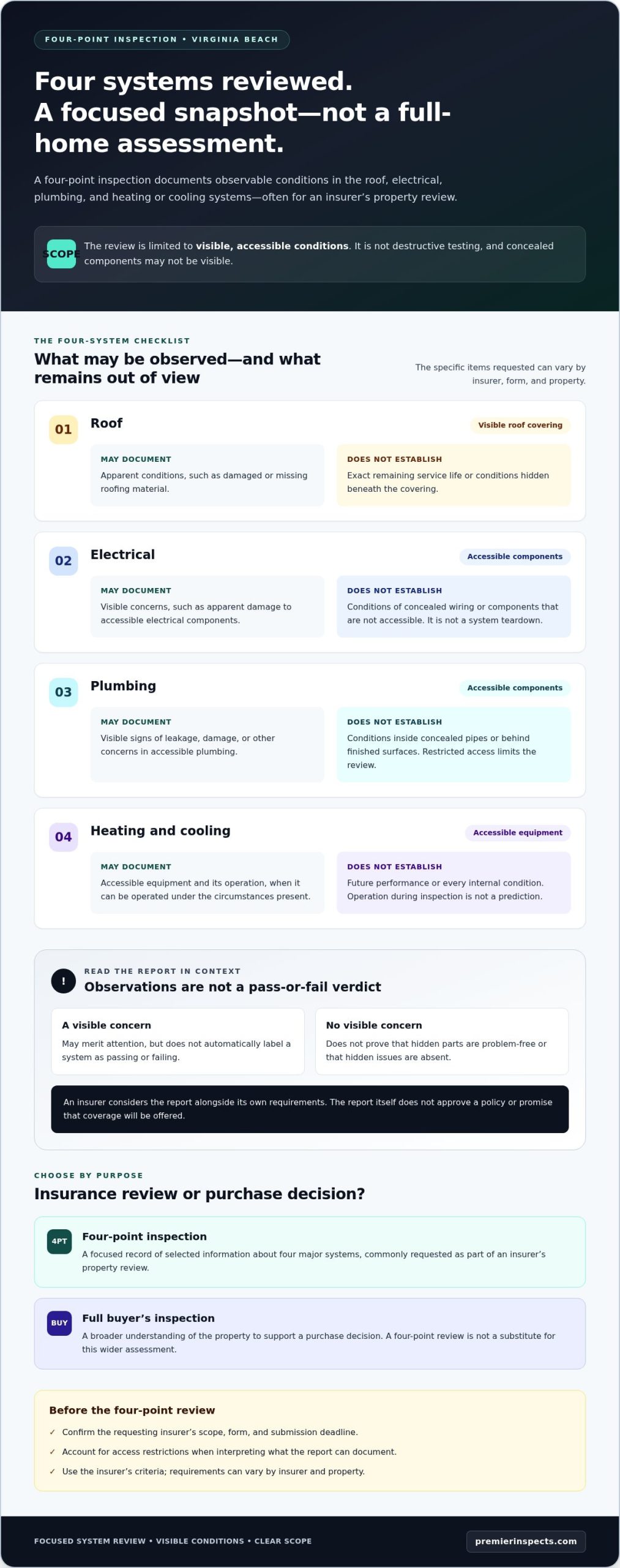
A four-point inspection reviews the visible, accessible condition of the roof, electrical, plumbing, and heating or cooling systems. The inspector documents observations within the agreed scope. This is not destructive testing, and concealed components may not be visible. Insurer forms and requested details can vary, so the specific report may cover different items from one request to another.
Roof and electrical system review
Roofing: The review may describe the visible roof covering and note apparent conditions, such as damaged or missing material. It doesn’t establish the roof’s exact remaining service life or reveal conditions hidden beneath the covering. Limited visibility affects what the report can establish.
Electrical: Accessible electrical components are observed for visible concerns, such as apparent damage. The review isn’t a teardown of the system, so it can’t speak to concealed wiring or components that aren’t accessible. Read findings as observations, not a complete diagnosis.
Plumbing and heating or cooling system review
Plumbing: The inspector may observe accessible plumbing components and document visible signs of leakage, damage, or other concerns. A visual review doesn’t establish conditions inside concealed pipes or behind finished surfaces. If access is restricted, that boundary should be clear in the report.
Heating and cooling: The review documents the condition of accessible equipment and its operation when it can be operated under the circumstances present. Operation at the time of inspection doesn’t predict future performance or reveal every internal condition. If a finding raises a concern, further evaluation by an appropriately qualified professional may help clarify it.
These system categories offer a snapshot, not a verdict on the entire home. A visible concern may merit attention, but the report doesn’t automatically label a system as passing or failing. Likewise, no visible concern doesn’t prove that hidden parts are problem-free. Use the written observations alongside the insurer’s criteria, and consider any access restrictions when interpreting the results.
For a buyer, the key question is purpose: do you need documentation about four systems for an insurance review, or a broader understanding of the property before purchase? A four-point review doesn’t replace a full buyer’s inspection. If you’re seeking broader purchase insight, you can book a buyer’s home inspection.
Four Point Inspection vs. Full Buyer’s Inspection: Which One Do You Need?
These inspections answer different questions. A four-point inspection documents selected information about four major systems, while a buyer’s inspection gives you a broader view of the property to support a purchase decision. Choose according to why you need an inspection, not simply because you’re buying a home.
| Comparison | Four-point inspection | Full buyer’s inspection |
|---|---|---|
| Purpose | Provide requested system information for an insurance review. | Help a buyer understand the home’s overall observable condition before purchase. |
| Typical scope | Roof, electrical, plumbing, and heating or cooling systems. | A broader review of the home’s accessible components and systems, according to the inspection’s defined scope. |
| Likely audience | Property owners or buyers whose insurer specifically requests four-system documentation. | Buyers seeking information to inform their purchase decisions. |
The distinction is significant: a four-point report doesn’t provide comprehensive information about components outside those four systems. It can’t stand in for a broader review of the property.
When is a four-point inspection the relevant request?
Choose this focused inspection when an insurer has specifically requested documentation about the four systems. Use the insurer’s stated scope, required form, and submission instructions as your guide. Requirements can differ, so don’t assume every buyer or property needs a four-point report. If the request is unclear, resolve the scope with the requesting insurer before arranging the inspection.
When should a buyer consider a full home inspection?
If your goal is to understand more of the home before committing to a purchase, a buyer’s inspection is the more relevant tool. It offers a broader review, though an inspection is still a visual evaluation with defined limits. A four-point report can’t represent every component or answer every question about the property.
For broader purchase guidance, explore the Virginia Beach homebuyer inspection service and the Virginia Beach home inspection overview. A pre-purchase home inspection Virginia Beach buyers arrange can provide detailed reporting to support informed decisions, while a four-point review addresses a narrower, insurer-requested need. Match the inspection to the decision you need to make.
How to Prepare for a Four Point Inspection in Virginia Beach
Preparation helps keep a four-point inspection focused and makes the report easier to understand. Start with the insurer’s request, rather than assumptions about what a standard form includes:
- Confirm the scope. Review the insurer’s requested systems, form, and submission instructions.
- Gather available records. Locate roof, system, service, maintenance, or prior inspection documents that may provide context. They can help explain known updates, but don’t assume every record is required.
- Arrange access. Make the four systems and relevant areas accessible where it’s safe to do so.
- Review the findings. Read the report’s observations and limitations before submitting it as requested.
What information and access can help?
Gather available details about the roof and equipment, such as service records or documents noting past updates. If you can do so safely, clear stored items away from electrical panels and mechanical equipment. Make sure the inspector can reach relevant areas without moving heavy objects or encountering hazards. Share known access limits and observations, such as a leak you’ve noticed or equipment that hasn’t been operating. For general tips, see this home inspection preparation guide.
Not every part of a system will be visible or accessible. Don’t open equipment, remove covers, or enter unsafe areas to prepare. If an attic, crawlspace, panel, or piece of equipment can’t be safely accessed, make that limitation clear so it can be considered during the inspection and documented appropriately.
What should you do after receiving the report?
Read the observations alongside any noted access limits, then submit the report according to the insurer’s instructions. Direct questions about whether findings affect coverage to the insurer making that decision. The inspection documents observed conditions; it doesn’t determine insurance approval. Where the report recommends further evaluation, a qualified specialist can assess the specific concern.
Preparing for a pre-purchase home inspection Virginia Beach buyers need starts with choosing the right scope for the decision at hand. A four-point review addresses a focused insurance request, while a buyer’s home inspection supports a broader understanding of the property. A Premier Home Inspection provides detailed reporting to help make observations clear.
Book a Virginia Beach Inspection with Clear Scope and Detailed Reporting
The best next step depends on the question you need answered. If an insurer has requested documentation about four systems, use its instructions to understand that focused request. If you’re buying a home and want broader information about its observable condition, a buyer’s home inspection is designed for that purpose. One inspection shouldn’t be treated as a substitute for the other.
A Premier Home Inspection serves Virginia Beach and the wider Hampton Roads area, including Chesapeake, Norfolk, Portsmouth, Suffolk, and Hampton. The veteran-owned business is led by Clay Somers, a Certified Master Inspector, and emphasizes integrity and detailed reporting. Clear documentation helps you understand what was observed, the report’s limits, and which findings may warrant further evaluation. This context can support informed property decisions without turning inspection findings into insurance approval or a guarantee about the home.
What to expect from a local inspection experience
Local experience brings familiarity with homes in Virginia Beach and across Hampton Roads. A report should communicate observed conditions and relevant access limitations so you can interpret the findings in context. A Premier Home Inspection also provides free RecallCHEK services, an additional resource related to product recalls. RecallCHEK doesn’t replace the inspection or expand its scope.
Book the inspection that matches your next decision
Before arranging an inspection, identify your immediate goal: responding to an insurer’s specific request or learning more about a property you’re considering. For purchase-focused guidance, review the Virginia Beach buyer inspection details. If you’re seeking a pre-purchase home inspection Virginia Beach buyers can use to inform a property decision, choose the broader buyer’s inspection rather than relying on a four-point review alone.
Once you’ve clarified your need, arrange the inspection that fits your next decision. Detailed reporting can help turn observations into a clearer understanding of the home.
Choose the Inspection That Moves You Forward
The right inspection depends on your immediate need. A four-point review documents observable conditions in the roof, electrical, plumbing, and heating or cooling systems, often in response to an insurer’s request. A buyer’s inspection offers a broader view of the property and is the better fit when you’re weighing a purchase. One does not replace the other.
For a pre-purchase home inspection Virginia Beach buyers can use to make informed decisions, clear reporting helps explain findings and inspection limitations. A Premier Home Inspection is veteran-owned and operated, led by Certified Master Inspector Clay Somers, and includes free RecallCHEK service. The company serves Virginia Beach, Chesapeake, Norfolk, Portsmouth, Suffolk, and Hampton.
Ready to better understand the home you’re considering? Arrange a buyer’s inspection that fits your purchase needs.
With the right scope and useful information in hand, you can move forward with greater clarity.
Frequently Asked Questions
What does a four-point inspection include?
A four-point inspection focuses on the roof, electrical, plumbing, and heating or cooling systems. It’s a limited visual assessment of accessible components, not an examination of every part of the home. The exact items documented depend on the requested form and inspection scope. Concealed or inaccessible areas may not be assessed, and the report describes observed conditions. It doesn’t guarantee insurance approval or establish that hidden problems are absent.
Do I need a four-point inspection to get homeowners insurance in Virginia Beach?
Not necessarily. An insurer may request a four-point inspection as part of its property review, but requirements can vary by insurance company, property, and circumstances. Virginia doesn’t universally require every homeowner to obtain one for coverage. If your insurer requests an inspection, follow its specific form and submission instructions. The inspector documents observable conditions; the insurer reviews the report and makes the coverage decision.
Is a four-point inspection the same as a home inspection?
No. A four-point inspection focuses on four major systems, while a buyer’s home inspection is intended to provide a broader view of a property’s observable condition. Neither type guarantees that future problems won’t occur. A four-point report shouldn’t replace the broader information a buyer may want before purchasing. For a pre-purchase home inspection Virginia Beach buyers can use to inform their decision, choose a buyer’s inspection with a scope suited to that purpose.
Can a four-point inspection affect my insurance coverage?
An insurer may consider a four-point report during its review, but the report itself doesn’t approve, deny, or guarantee coverage. The insurer makes its decision using its own criteria and review of the property and documentation. Direct questions about how a finding may affect your policy to the insurer. Use the inspection report to understand observed conditions in the listed systems, including any access limits.
How long does a four-point inspection take?
There isn’t one fixed duration for every four-point inspection. Property size, access, and observed conditions can affect the on-site visit, even though the review is limited to four system categories. The inspector still needs time to examine accessible components and document observations. Report preparation is separate from the inspection itself, so don’t assume the visit’s length indicates when the completed report will be available.
What should I have ready for a four-point inspection?
Make relevant areas safely accessible and gather available roof, plumbing, electrical, or HVAC records. Have the insurer’s request or form available so the requested scope is clear. Service documents and prior inspection reports may provide useful context, but missing records don’t replace the inspection. Tell the inspector about known access limits or concerns. If a component can’t be reached safely, that may affect what can be observed and documented.
Does a four-point inspection check for every problem in a home?
No. A four-point inspection is a focused review of the roof, electrical, plumbing, and heating or cooling systems, not a comprehensive assessment of the entire property. Concealed areas, inaccessible components, and systems outside those categories may fall beyond its scope. Buyers who want to understand more of a home’s observable condition may choose a broader buyer’s inspection, while separately following any inspection requirements set by their insurer.