

What can an inspector document once framing, wiring, or plumbing is covered by drywall? Timing matters on a new build. A new construction phase inspection Virginia Beach buyers arrange before work is concealed can provide a clear record of conditions that are visible and accessible at that stage. It’s understandable to wonder which phases are worth inspecting, especially when builder quality control and municipal inspections are already part of the process. An independent inspection provides another perspective and complements those processes rather than replacing them.
In this guide, you’ll learn why pre-pour, pre-drywall, and final inspections matter, what an inspector can document at each stage, and how to coordinate access before construction moves forward. You’ll also learn how to review findings and share them with the builder while the relevant work is still accessible. A Premier Home Inspection serves Hampton Roads, including Virginia Beach, with detailed reporting led by Clay Somers, a Certified Master Inspector. The goal isn’t to promise defect-free construction. It’s to give you a clearer view of your home’s condition and support informed decisions as the build progresses.
Key Takeaways
- Time inspections around construction milestones, while key work is still accessible, rather than relying on fixed calendar dates.
- A new construction phase inspection Virginia Beach buyers arrange can document visible conditions independently of builder quality control and municipal inspections.
- Coordinate the inspection around site readiness, arrange access through the builder’s process, and share relevant project details.
- Use the inspection report to understand documented observations and make informed decisions as construction progresses.
- A Premier Home Inspection serves Hampton Roads with phase inspections led by Clay Somers, a Certified Master Inspector.
Why Schedule a New Construction Phase Inspection in Virginia Beach?
What can an independent review reveal before construction moves on and work is covered? A new construction phase inspection Virginia Beach buyers arrange at an agreed milestone can document visible conditions while parts of the home remain accessible. That timing gives you information about the home as it is being built, rather than relying only on what can be seen after completion.
A phase inspection is an independent visual assessment at an agreed point in construction, intended to document observable conditions and give buyers clearer information as the home takes shape. The report describes what was visible and within the agreed scope at the time of inspection. It isn’t a guarantee of future performance, a promise that construction is defect-free, or a substitute for builder quality control or local building inspections.
What does an independent phase inspection add?
Builder quality control, local building inspections, and an independent inspection serve different purposes. A builder’s quality-control process supports the builder’s work. Local building inspections are part of the public process for reviewing construction against applicable requirements. Municipal inspectors’ role in the broader construction process is distinct from a buyer-focused assessment.
An independent report gives you a separate, documented perspective on visible conditions. At an accessible stage, an inspector may be able to observe aspects of the work that will be harder to see once finishes are installed. The report helps you understand what was observed and discuss relevant findings with the builder. It doesn’t establish that every part of the home was inspected or that every concern will be visible.
Access and scope matter. A visual assessment is limited to areas that can be safely accessed and observed at the agreed inspection point. Stored materials, closed-off areas, concealed components, or work already covered may limit what can be assessed. Independent findings complement other reviews; they don’t replace them.
How is it different from a buyer inspection after construction?
During construction, a phase inspection focuses on accessible work at a particular milestone. Staged access may offer a view of conditions before they’re concealed, but the report is limited to what can be observed at that time. By contrast, a buyer inspection near completion looks at the completed, accessible home. Finishes and installed systems can be assessed in their completed state, while covered construction generally can’t be viewed directly.
These inspections answer related but different questions. A phase report records observations at one point in the build; a later inspection provides information about the home closer to purchase or completion. A Virginia Beach homebuyer inspection may offer useful perspective near that stage, alongside any phase inspections. Together, reports from different points can help you make informed decisions, though no single inspection reveals everything behind finished surfaces.
Which Construction Phases Are the Best Times to Inspect?
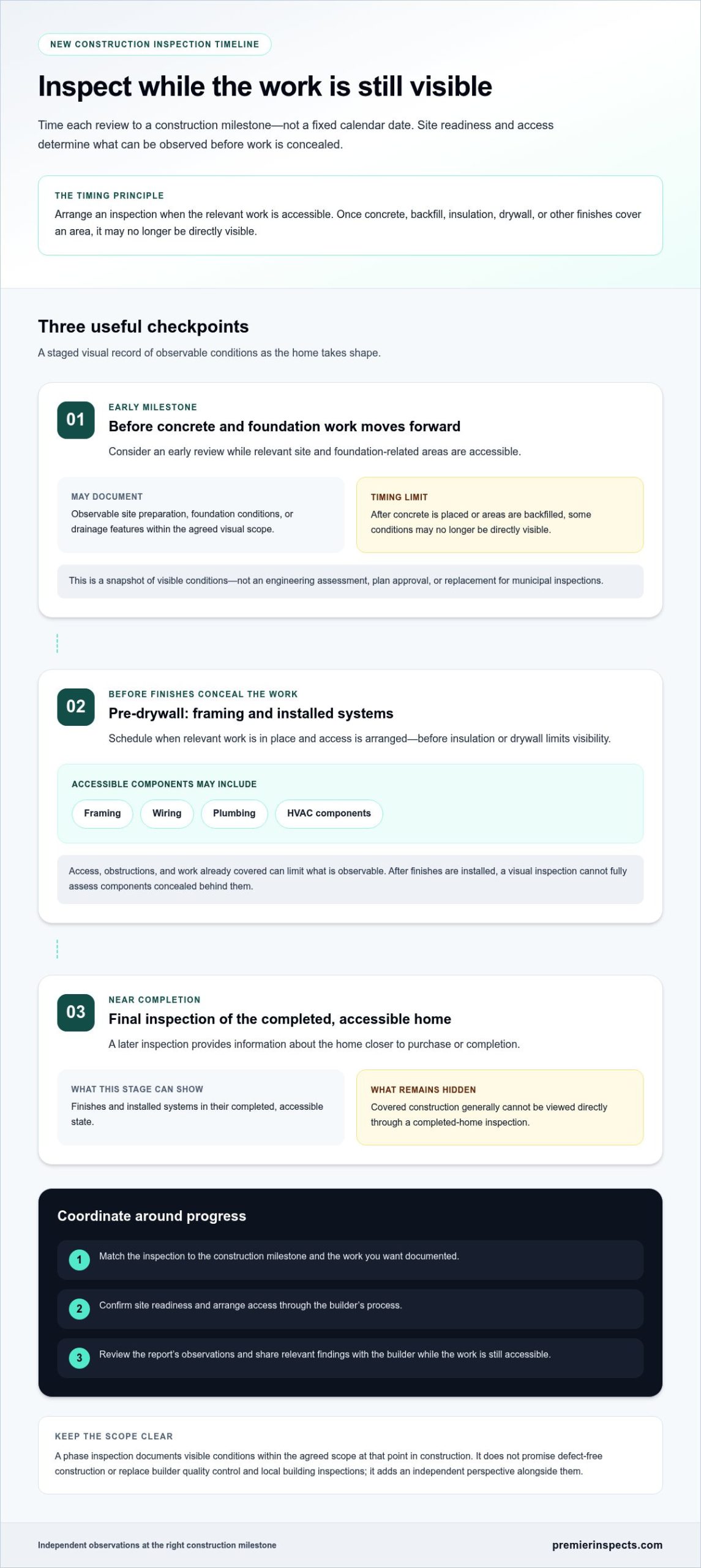
The most useful inspection point is the one that lines up with work you want documented before it changes or becomes concealed. A common sequence includes an early foundation-related opportunity, a pre-drywall review, and a final inspection near completion. These are potential milestones, not fixed appointments. Construction schedules, site readiness, and access vary from one Virginia Beach build to another.
Inspection timing shapes what can be observed: schedule a review while the relevant work is accessible, because finishes can conceal it from view later. Coordinate around actual progress rather than assuming a certain number of days after a pour or framing start. A calendar date can arrive before a site is ready, or after the work you hoped to see has already been covered.
Before concrete and foundation work moves forward
An early review may be useful when relevant site and foundation-related areas are accessible. Within the agreed visual scope, an inspector may document observable site preparation, foundation conditions, or drainage features. This is a snapshot of visible conditions, not an engineering assessment, approval of the plans, or replacement for municipal inspections. For code context, the Virginia Construction Code page outlines Virginia’s code adoption information; an independent inspection serves a different, buyer-focused purpose.
Timing is central at this stage. Once concrete is placed or areas are backfilled, some conditions may no longer be directly visible. An inspection can document what is accessible at the time, but it can’t assess concealed work simply because it was once exposed.
Before framing and mechanical systems are covered
A pre-drywall inspection can provide a view of accessible framing and installed wiring, plumbing, and HVAC components before wall and ceiling finishes hide them. The right moment depends on construction progress: the relevant work needs to be in place, and access needs to be arranged before insulation or drywall limits visibility. Coordinate the inspection with the actual milestone rather than relying on a routine date.
Once finishes are installed, a visual inspection can’t fully assess components concealed behind them. A pre-drywall review also can’t see every detail: access, obstructions, and the agreed scope define what can be observed. If a stage has passed, focus on what remains accessible and what a later inspection can document instead.
Near completion, a final inspection can document accessible features and conditions in the finished home. It complements earlier reviews, since each stage offers a different view; it can’t recreate access to covered framing or systems. A new construction phase inspection Virginia Beach buyers coordinate around these milestones can provide useful records as the build advances. If you’re planning an inspection, you can schedule a phase inspection around the home’s progress and access arrangements.
What Should Virginia Beach Buyers Know About Inspections and Local Conditions?
Does builder quality control and municipal review make an independent inspection redundant? No. These processes have different purposes. Builder quality control supports the builder’s work, while local building inspections are part of the applicable code-compliance process. A buyer-focused inspection provides a separate record of observable conditions, helping you understand what was visible at the time and make informed decisions about your home.
Builder, municipal, and independent inspections each have a different purpose and scope; one process doesn’t automatically replace the others. An independent review isn’t a substitute for code review or builder processes, and it doesn’t determine compliance or guarantee future performance. It adds a documented buyer perspective alongside them.
| Inspection role | Main purpose | What it means for the buyer |
|---|---|---|
| Builder quality control | Supports the builder’s work and internal construction process. | Provides the builder’s perspective on work underway. |
| Local building inspections | Part of the local process for reviewing applicable code requirements. | Serves a public compliance function distinct from a buyer’s independent review. |
| Independent buyer-focused inspection | Documents observable conditions within the agreed inspection scope. | Offers a separate report to inform the buyer’s understanding and discussions. |
Do city inspections replace an independent inspection?
No. A local inspection process and an independent review are not interchangeable. Municipal inspections relate to applicable code requirements and the local review process. An independent inspection focuses on visible conditions from the buyer’s perspective. It doesn’t duplicate or overrule the city’s role, and its observations shouldn’t be read as municipal approval or a complete assessment of concealed work.
For a new construction phase inspection Virginia Beach buyers can use as an additional source of information, the report’s value is its clarity about what was observed, where, and within what scope. That distinction can help keep conversations with the builder focused on documented conditions rather than assumptions. The broader case for independent oversight for new construction is relevant when you want to understand how a buyer-focused perspective fits alongside other project reviews.
Which site and exterior details deserve local attention?
Look at the home in context, not through assumptions about every Virginia Beach property. Lot slope, nearby surfaces, roof runoff, and the home’s exposure can shape what merits attention. An inspector may document visible grading and drainage patterns, how roof runoff is directed, or moisture indicators on accessible surfaces. These observations describe conditions at the time of inspection; they don’t establish a cause or predict how a site will perform in every weather condition.
For example, note whether visible ground surfaces appear to direct water toward or away from the home, and whether accessible exterior areas show signs of moisture. Each lot is different. A detailed, independent report gives buyers a clearer record to consider in the context of the specific site and construction.
How Can You Coordinate a New Construction Inspection Without Disrupting the Build?
A well-timed inspection fits the construction schedule rather than interrupting it. Start by identifying the milestone you want documented, then coordinate site access around actual progress and the builder’s process. For a new construction phase inspection Virginia Beach buyers arrange, readiness matters: the relevant work should be available to observe, and the site must be accessible under its safety rules.
Keep expectations practical. An independent inspection documents observable conditions within its agreed scope. It doesn’t direct the construction crew, approve the project, or perform repairs. Clear communication before the appointment helps everyone understand the purpose of the visit and what information may be useful.
A practical scheduling and preparation checklist
Use a short sequence to prepare, and adjust it to the project’s progress:
- Identify the milestone. Track construction updates and note when the areas you want reviewed are expected to be accessible. Avoid relying only on a calendar date.
- Coordinate access. Follow the builder’s process for arranging entry, confirm where the inspector may go, and understand any site safety expectations before the appointment.
- Share context. Provide available plans, project details, or specific questions that may help frame the inspection. These materials offer context, but don’t expand what can be visually observed.
- Align timing with readiness. If construction progress changes, revisit the appointment timing so the inspection corresponds to the intended milestone.
This preparation keeps the visit focused. It also helps avoid arriving before the relevant work is present or after it has been covered. Schedule around the site’s actual status and established entry arrangements.
How to use the inspection report constructively
Review the report promptly while the observations are fresh. Look at each documented condition, its location, and any supporting photos included in the report. Photos paired with written observations can help you understand what was visible and explain a concern clearly when you discuss it through the appropriate project channels.
Keep observations distinct from next steps. A report may document a visible condition, while a recommendation may call for further evaluation by an appropriate specialist. Neither means the inspector is directing construction or determining how the builder must respond. Use the report to ask focused questions, share relevant findings, and keep a record of the discussion. An inspection provides information for your decisions, not a substitute for the project’s communication and approval processes.
What to Expect from A Premier Home Inspection in Virginia Beach
Building a home involves many decisions, and clear information can help you understand what is visible at important points in the process. A Premier Home Inspection provides new construction phase inspections across Hampton Roads, including Virginia Beach. The purpose is practical: document observable conditions within the agreed inspection scope so you have a clearer basis for informed discussions and decisions.
The report records what could be observed at the time of inspection. It isn’t a promise of flawless construction or a prediction of how the home will perform in the future. A careful, buyer-focused assessment can still bring clarity to a complicated build, especially when findings are described in plain language and kept distinct from conclusions outside the inspection’s scope.
How an experienced inspector supports an informed build
A Premier Home Inspection is veteran-owned and operated, and led by Clay Somers, a Certified Master Inspector. During a new construction phase inspection Virginia Beach clients receive an independent perspective and detailed reporting to help them understand documented observations.
That distinction matters. A finding should identify an observable condition and give the buyer useful context for considering it. Where a report identifies an item that may need further evaluation, that is different from diagnosing the cause or prescribing construction work. The inspection documents; it doesn’t direct the builder or perform repairs.
Use the report to organize follow-up conversations around specific observations. Instead of relying on a general impression that something “looks wrong,” refer to the report’s description and the location of the condition. This supports clearer communication while leaving project decisions and construction work with the appropriate parties.
Plan for the final handoff and warranty period
An inspection near completion serves a different purpose from earlier phase visits. Earlier reviews document conditions accessible during construction; a final-stage inspection considers the completed, accessible home. Each offers a distinct view, and the later inspection doesn’t recreate access to work that has since been concealed. Thinking ahead about both stages can help you understand what each report can and can’t tell you.
After moving into a new home, owners may also want a review as the builder’s warranty period approaches. A Premier Home Inspection offers 11th-month warranty inspections, providing a separate opportunity to document observable conditions at that later point. It complements, rather than replaces, observations made during construction.
For a Virginia Beach build, detailed reporting and an independent perspective can help you make better-informed decisions. Choose an inspection point that fits your project’s progress, then arrange your next step.
Book your Virginia Beach inspection
Make Your Next Build Decision With Clarity
Your next step is to connect inspection timing to a real construction milestone. As the build progresses, track when the areas you want documented will be accessible, then plan around site readiness and the builder’s access process. A new construction phase inspection Virginia Beach buyers coordinate at the right moment can give them useful observations to consider while decisions are still unfolding.
Approach the report as a practical record, not a verdict on the entire home. Use its observations to focus your questions, organize relevant project discussions, and decide what follow-up may be appropriate. That steady, informed approach can make the construction process feel more manageable without expecting any inspection to predict every future condition.
Take the next step by choosing a milestone that fits your build and arranging an independent review around it. A Premier Home Inspection’s detailed reporting is designed to support informed property decisions, with Clay Somers, a Certified Master Inspector, leading the veteran-owned and operated business serving Chesapeake, Norfolk, Virginia Beach, Portsmouth, Suffolk, and Hampton.
With a clear plan and an independent record of observations, you can move forward with greater confidence as your Virginia Beach home takes shape.
Frequently Asked Questions
Is a new construction phase inspection required in Virginia Beach?
No, a private new construction phase inspection Virginia Beach buyers arrange is separate from the municipal inspection process. City inspections are part of the building-permit process, while an independent inspection provides buyer-focused observations. If you’re reviewing your purchase documents, look for any inspection-related terms or deadlines that apply to your transaction. This can help you plan an independent review without confusing it with required project approvals.
Can an independent inspection guarantee that a new home has no defects?
No inspection can guarantee a defect-free home. An inspection records conditions that are observable and within the agreed scope at that time. A concern behind a finished wall, for example, may not be visible, and a later change in conditions can’t be predicted from a single visit. Treat the report as a practical snapshot to inform your decisions, not as a promise about every component or future performance.
What happens if a construction phase is already covered up?
Once work is concealed, an inspector generally can’t assess it visually without access to the covered area. The report can still document other accessible conditions, but it shouldn’t imply that hidden work was reviewed. If you missed a milestone, keep any construction records or photographs you already have and focus the next inspection on what can be seen. The report can clarify the limits of that later review.
Can a phase inspection delay construction or closing?
An inspection doesn’t automatically delay construction or closing, but timing and access need to fit the project schedule. A visit arranged after the relevant area has been closed in may not provide the observations you intended. Share the milestone and site-access plan through the project’s established channels, and allow time to review the report before important decisions. Don’t assume a private inspection changes a builder’s schedule or closing terms.
Can buyers attend a new construction phase inspection?
Buyer attendance depends on site access and safety arrangements. If you’re permitted to attend, wear any required protective equipment, follow site instructions, and let the inspector focus on the assessment. Note questions as they arise and use the written report afterward to revisit observations. If attendance isn’t permitted, the report can still give you a record to review and discuss through the appropriate project channels.
What should I do if the builder disagrees with an inspection finding?
Start with the specific report entry, including its location, description, and any supporting photo. Ask for the disagreement or explanation to be addressed through the project’s usual communication process, and keep relevant responses with your inspection records. An inspection finding documents an observation; it doesn’t compel a particular construction decision. If the report identifies a need for further evaluation, treat that separately from the observed condition and consider appropriate specialist input.
Is a final inspection enough if I missed an earlier construction phase?
A final inspection can be useful, but it can’t provide the same view of framing or other work that was accessible before finishes went in. It focuses on conditions visible in the completed home, so a missed earlier stage may leave some construction details outside direct visual review. Keep expectations grounded in what’s accessible now. For new builds across Hampton Roads, including Chesapeake, Norfolk, Portsmouth, Suffolk, and Hampton, a later inspection can still provide useful documented observations.