

A pool that looks ready for a summer swim may still have visible concerns worth understanding before closing. A pool inspection Virginia Beach buyers arrange can document observable conditions and help you decide whether any findings need follow-up. It can’t predict every future issue or certify that a pool is completely safe, but it can give you a clearer picture of its condition on inspection day.
It’s natural to wonder whether a finding points to a significant concern or routine upkeep. A Premier Home Inspection provides pool and spa assessments in Virginia Beach and throughout Hampton Roads, with clear reporting to support informed property decisions.
This guide explains what an assessment may cover, how to distinguish maintenance notes from condition concerns, and how to prepare for the inspection. You’ll also learn how to use the report to identify questions that may call for specialist evaluation or additional testing before closing.
Key Takeaways
- A pool inspection Virginia Beach buyers arrange documents observable conditions within the assessment scope. It can’t guarantee future performance or certify complete safety.
- Understand the assessment scope before interpreting findings. The areas reviewed depend on what is included and accessible.
- Distinguish routine upkeep from visible condition concerns, and use the report to identify observations that may need specialist review.
- Share known pool or spa concerns and relevant property information ahead of the assessment to provide useful context.
- Use clear findings to organize follow-up questions and make better-informed decisions before closing.
Why a Pool Inspection Matters When Buying a Virginia Beach Home
A pool can look clean and inviting during a showing while visible concerns go unnoticed. A pool inspection Virginia Beach buyers arrange records observable conditions within the agreed assessment scope. It provides information to consider before closing, but it isn’t a guarantee of future performance, a repair diagnosis, or a certification that the pool is completely safe.
Including the pool in your due diligence helps you understand another significant feature of the property, beyond the rooms, roof, and other parts of the home. Inspection observations can help you prepare specific questions, decide whether further evaluation is appropriate, and plan with a clearer view of what you’re buying. A pool assessment can complement broader Virginia Beach homebuyer inspection services as part of that process.
What a buyer can learn from a pool assessment
An assessment documents visible pool or spa conditions according to its scope. The areas reviewed can vary, so don’t assume every component or test is included. The report helps you understand what was observable on inspection day and identify items that may need clarification or further attention.
Equipment can provide information beyond the pool’s appearance, when it is accessible and included in the scope. A swimming pool service technician may handle ongoing maintenance and equipment work, which differs from an inspection that records observable conditions. Keep the distinction in mind: an observation doesn’t prove a hidden defect, predict a future failure, or estimate repair needs.
Why appearance alone is not enough
Clear water can make a pool look well cared for, but it doesn’t establish the condition of every visible surface or piece of equipment. For example, an inspector might note a visible crack or equipment that appears not to operate during the assessment, if that area is within scope. The observation may prompt a question or further evaluation, but it doesn’t establish the cause, extent, or likely cost of the concern.
Read findings as a record of what was observed, not as a conclusion about concealed conditions or what may happen later. If a finding raises a question, use the report to decide what additional information could help before closing. A specialist evaluation or additional testing may be appropriate when the question goes beyond the original assessment.
Inspection information supports a considered purchase decision, but it doesn’t replace routine pool care, ongoing monitoring, or a separate evaluation you decide is needed. A Premier Home Inspection provides pool and spa assessments in Virginia Beach and the broader Hampton Roads area, with reporting that helps buyers understand visible conditions and plan informed next steps.
What a Pool Inspection Can Examine: Surfaces, Equipment, and Safety
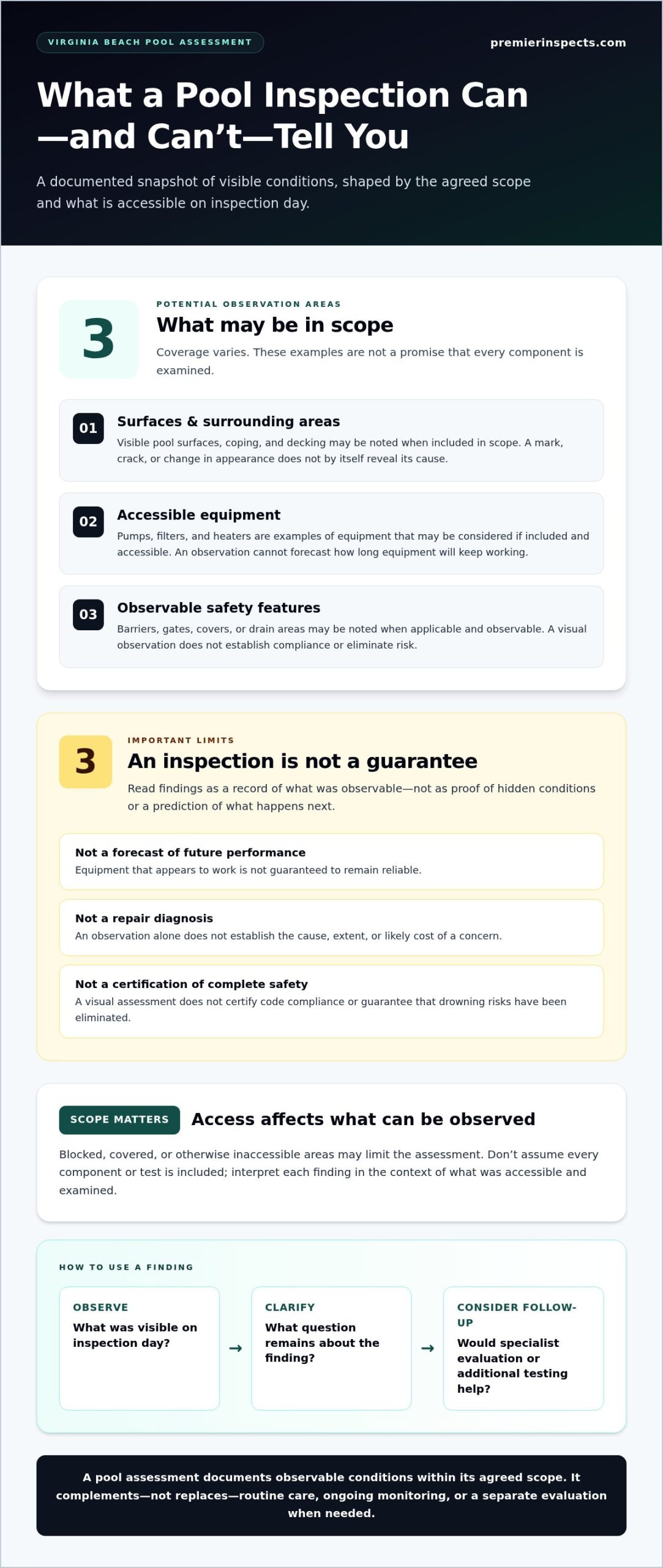
What does a pool assessment cover? The answer depends on the agreed scope and what is accessible on the day. A pool inspection Virginia Beach buyers arrange can document visible conditions in the pool and spa area, but it shouldn’t be treated as a promise that every component has been tested or every concealed issue found. Understanding the scope helps you read the report accurately and identify what questions remain.
Pool inspection: A documented assessment of visible conditions within the agreed scope. The areas reviewed can vary, so interpret findings in the context of what was accessible and examined.
Depending on the scope and accessibility, observations may relate to areas such as:
- Surfaces and surrounding areas: Visible pool surfaces, coping, and decking may be noted if they are within scope. An observation describes what could be seen, not necessarily the cause of a mark, crack, or change in appearance.
- Accessible equipment: Equipment may be considered when it is included and accessible. Pumps, filters, and heaters are examples, not a claim that each is examined in every assessment.
- Observable safety features: Barriers, gates, covers, or drain areas may be noted when applicable to the agreed scope. A visible observation does not establish compliance with every applicable requirement or eliminate risk.
Visual observations are not a substitute for specialized testing or a diagnosis of concealed conditions.
Pool surfaces and accessible equipment
Visible surfaces can offer useful information about current appearance and condition. For instance, a noticeable change in coping or decking may be recorded for you to consider, but the observation alone may not explain its cause. Access matters, too. Items that are blocked, covered, or otherwise inaccessible may limit what can be observed during the assessment.
If pumps, filters, or heaters are included in the scope, the report may describe their visible condition or operation at the time of assessment. It can’t establish how long equipment will continue working. The report is a snapshot, not a service-life forecast. Don’t assume a component that appears to work is guaranteed to remain reliable, or that an observed concern amounts to a complete repair diagnosis.
Visible safety features and inspection limits
Visible barriers, gates, covers, or drain areas may raise questions worth addressing when they are applicable to the assessment and observable. A pool inspection doesn’t certify code compliance or guarantee that drowning risks have been eliminated. A safety concern may require a more specific evaluation than a visual assessment provides.
If a report identifies an issue that depends on testing, technical diagnosis, or evaluation beyond the inspection scope, consider a qualified specialist evaluation. That can help clarify what the observation means before you decide on next steps. Keep the report’s limits in view, and don’t treat an unmentioned or inaccessible component as having been tested. To arrange an assessment as part of your property due diligence, schedule a pool and spa inspection.
How to Compare Pool Inspection Findings and Decide What Needs Follow-Up
A report may include observations that call for different responses. A note about routine cleaning isn’t automatically a defect. An unclear finding, or one that falls outside the assessment’s limits, may warrant more investigation. For a pool inspection Virginia Beach buyers can use the report as a decision aid, not as a repair diagnosis or price estimate.
| Finding category | What it may indicate | Possible next step |
|---|---|---|
| Routine upkeep | Visible debris or a need for ordinary cleaning may reflect care between uses, rather than a defect. | Consider what routine attention may be needed after purchase. Don’t treat upkeep alone as proof of a larger problem. |
| Visible condition concern | An observable change, such as a chipped surface or a component that appears unusual, merits understanding in context. | Review the report description and consider whether further clarification would help you assess its relevance. |
| Possible specialist review | An uncertain, inaccessible, or technically complex condition may not be resolved by visual observation. | Consider a qualified specialist evaluation or additional testing to answer questions beyond the inspection scope. |
Routine maintenance versus a condition concern
Separate ordinary care from an observation about a component’s visible condition. Leaves in the pool may call for cleaning, while a visible chip is a condition to understand, not automatic proof of a serious defect. A report that describes what was observed and the context can help you avoid treating every maintenance note as a hazard or repair need.
Read the wording closely. Does the report describe a visible fact, or does it leave an open question? Keep those points separate. The observation may be clear even when its cause or significance isn’t.
When a finding suggests additional evaluation
Use three questions to organize follow-up: How relevant is it? Could it affect your intended use or purchase planning? How uncertain is it? Is the observation straightforward, or were access limitations or an unknown cause part of the assessment? What evaluation would resolve the uncertainty? A specialist may be able to address technical questions a visual assessment can’t answer.
Don’t turn an inspection note into a diagnosis or assume it predicts repair needs. Instead, identify the exact observation, what remains unclear, and whether more information could change your decision. A Virginia Beach pool inspection buyer’s guide offers broader context as you weigh the pool alongside the rest of the purchase. The report supports informed planning; it doesn’t dictate a negotiation outcome.
How to Prepare for a Pool Inspection in Virginia Beach
Preparation can make a pool assessment easier to coordinate and help you get more value from the findings. For a pool inspection Virginia Beach buyers can share useful context, support access to observable areas, and coordinate the assessment with the rest of their purchase due diligence. Conditions at the property may still limit what can be observed, so preparation doesn’t guarantee that every area or component will be accessible.
Before the inspection appointment
- Coordinate timing with your property inspection. As you organize due diligence, consider how the pool assessment fits alongside the broader home inspection. A Virginia Beach home inspection can form part of your overall property review, while the pool assessment focuses on its own agreed scope.
- Gather what you already know. Make a short list of questions about visible pool or spa features and any concerns described to you. Share relevant maintenance history, service records, or other pool documentation if you have it. These materials provide context, but they don’t replace observations made during the assessment.
- Consider access to relevant areas. Think about whether gates, storage, furniture, or other obstructions may affect access to areas you’d like observed. Coordinate access through the appropriate property representative. Clear access can support a more useful visual assessment, although conditions at the home may still limit what can be examined.
For general steps to prepare for a property inspection, use this home inspection preparation guide. Pool-specific questions and available records are useful additions.
During and after the assessment
If you’re present or reviewing the report afterward, focus on what was actually observed. Ask for clarification about the report’s wording, what the finding means within the assessment scope, and whether it describes an observation or recommends further evaluation. This keeps your next step grounded in the report rather than assumptions about cause, repair, or future performance.
As you review, separate three things: the documented condition, any limits that affected what could be observed, and any suggested follow-up. A recommendation for additional evaluation means a question remains; it isn’t a diagnosis or estimate. If the report points to a technical issue beyond a visual assessment, a qualified specialist may be able to provide further evaluation.
Use the findings to organize purchase questions and decide whether you need more information before closing. A pool assessment adds useful detail to coordinated property due diligence, but it doesn’t replace other inspections or ongoing pool care.
Book a Virginia Beach Pool Inspection with A Premier Home Inspection
Buying a home with a pool adds another important feature to assess before closing. A pool inspection Virginia Beach buyers arrange can document observable conditions within the agreed scope, giving you information to consider alongside the rest of your property due diligence. It won’t guarantee a defect-free pool, predict every future problem, or certify that the pool is completely safe. It can, however, replace guesswork with documented findings.
A Premier Home Inspection provides pool and spa assessments in Virginia Beach and throughout Hampton Roads, including Chesapeake, Norfolk, Portsmouth, Suffolk, and Hampton. The veteran-owned business is led by Clay Somers, a Certified Master Inspector, and provides detailed reporting to help buyers understand findings and plan informed follow-up.
What to expect from a clear inspection report
A useful report puts observations into context. It helps distinguish what was documented during the assessment from questions that remain unresolved, including matters that may need evaluation beyond its scope. That clarity can help you organize follow-up and identify what information you still need before making a purchase decision.
An inspection report isn’t a repair diagnosis or cost estimate. A visible concern may warrant further evaluation, but the report doesn’t establish its cause or prescribe repair work. Likewise, an area or component that wasn’t accessible shouldn’t be treated as having been evaluated. Keep the report’s scope and limitations in view as you consider next steps.
Take the next step with confidence
Use the findings as one part of your decision-making, alongside your questions about the home and any additional evaluations you consider appropriate. If a report raises a technical question, a qualified specialist may be able to assess it further. A pool inspection supports informed planning, but it doesn’t replace ongoing care or guarantee future performance.
For Virginia Beach buyers, arranging a pool and spa assessment as part of due diligence can bring visible conditions into focus before closing. A Premier Home Inspection serves homeowners and buyers across Hampton Roads, with reporting designed to support clearer property decisions. Use the findings to plan your next step with confidence.
Make Your Next Step a Confident One
As closing approaches, the most useful question isn’t whether a pool will remain problem-free. No inspection can promise that. Instead, consider whether you have clear enough information to make your next decision and whether open questions deserve follow-up before the transaction moves forward. A pool inspection Virginia Beach buyers schedule can provide a documented reference point, helping you consider the pool as part of the property rather than relying only on a showing-day impression.
Keep the report with your other purchase records, note unanswered questions, and decide what additional information would help you move forward. If a specialist evaluation is appropriate, the recorded observations can help focus that next step. This measured approach keeps uncertainty in perspective without treating every note as a reason for alarm.
Give yourself time before closing to review the findings and consider how they fit your plans for the property. A clear decision process can help you move forward thoughtfully, whether you proceed with the information available or seek more information first.
A thorough assessment is a practical step toward understanding the home you’re preparing to own.
Frequently Asked Questions
What does a pool inspection include when buying a house?
A pool inspection documents observable conditions within the agreed assessment scope, and the specific items reviewed can vary. Clarify whether the assessment covers the pool, spa, or accessible equipment relevant to your concerns rather than assuming every system is included. The report helps distinguish observed conditions from unanswered questions. Sharing known issues and available property records provides useful context.
Is a pool inspection separate from a home inspection?
A pool assessment is a distinct specialized inspection, so don’t assume a general home inspection evaluates the pool in detail. Buyers may arrange it as a separate part of their property due diligence. This distinction helps when planning inspections: a general report may address the home while leaving pool-specific questions unanswered. Review the scope of each assessment to understand what information each report is intended to provide.
Can a pool inspection identify hidden leaks?
A visual pool inspection generally can’t confirm a concealed leak or pinpoint its source. An inspector may document an observable concern, but determining whether water loss comes from a leak, evaporation, or another cause can require specialized testing. Share any history of unexplained water loss or records that describe it. A qualified specialist can evaluate questions that visual observations don’t resolve.
How long does a pool inspection take?
There isn’t one dependable duration for every pool assessment. Timing can depend on the agreed scope, the pool or spa setup, and whether relevant areas are accessible. Plan the assessment within your purchase timeline and allow time to review the report afterward. That review gives you a chance to identify questions or follow-up needs before closing.
Do I need a pool inspection when buying a home in Virginia Beach?
A pool inspection Virginia Beach buyers arrange is one part of due diligence, not a substitute for deciding what information you need before purchase. If a pool is part of the property, an assessment can help you understand its observable condition and identify questions that may warrant further evaluation. Buyers across Hampton Roads, including Chesapeake, Norfolk, Portsmouth, Suffolk, and Hampton, can consider pool condition alongside other property factors.
Can a pool inspection certify that a pool is safe?
No. A pool inspection isn’t a certification that a pool is completely safe, free of hazards, or compliant with every applicable requirement. It documents observations within its scope and under the conditions present at the time. Don’t rely on a report as a substitute for active supervision, appropriate safety practices, or any separate evaluation needed to address a specific safety concern.
What should I do if a pool inspection finds a problem?
Start by identifying exactly what the report observed and whether it recommends additional evaluation. Ask for clarification if the description or its limits aren’t clear. If the issue requires technical testing or diagnosis, a qualified specialist may provide information beyond the inspection’s scope. Use that added information to consider your next steps and purchase planning. An inspection finding alone doesn’t dictate a particular negotiation outcome.
Is a pool inspection the same as a pool maintenance service?
No. An inspection documents conditions observed during an assessment; maintenance involves ongoing tasks such as cleaning, water care, and routine equipment upkeep. An inspection report doesn’t mean the pool has been cleaned, serviced, or repaired, and it doesn’t replace regular care after purchase. Keeping these roles separate helps you understand what the assessment tells you and what ongoing attention the pool may require.
Buying in Virginia Beach or elsewhere in Hampton Roads? Schedule a pool and spa inspection with A Premier Home Inspection to add documented findings to your purchase due diligence.